6 Best Under Sink Water Filters (October 2026)
The best under sink water filters include the Waterdrop TSU for busy households, the CuZn UC-200 for no-drill kitchens, and the Waterdrop UA-5Y for fewer replacements.
On this page (7 sections)
- Which under sink water filter fits your kitchen?
- The best under sink water filters for different households
- How do you choose the best under sink water filter?
- What should you check before installing an under sink filter?
- How do you care for an under sink water filter?
- Which common buying mistakes should you avoid?
- Which best under sink water filter should you pick?
The best under sink water filter overall is the Waterdrop TSU if you want a dedicated drinking-water faucet and reminders for filter changes. Choose the CuZn UC-200 when countertop drilling is off the table, or the Waterdrop UA-5Y when fewer replacements matter most.
These picks retain dissolved minerals rather than lowering TDS. If dissolved-solids reduction is your goal, start with our under sink water filter and reverse osmosis comparison.
Your best choice depends on the water coming into the kitchen, the faucet you want to use and the cabinet space you can spare. A filter that fits those needs is more useful than one chosen for the highest stage count.
Our picks at a glance
-
1

-
2
-
3

Which under sink water filter fits your kitchen?
Choose a dedicated-faucet system to separate drinking water from routine sink use, or a direct-connect filter to get filtered cold water from your main tap. Then compare the substances each model addresses and the maintenance it requires.
PleasantlySimple compared faucet arrangements, source-water limits, replacement schedules, cabinet fit and stated reduction features. The scores reflect that combination, while the badges identify the buyer each model suits.
Don't use the scores as a contaminant-removal ranking. Start with your water needs, then use the comparison to narrow the practical choices.
| Product | Best for | Filter life | Flow rate | Faucet setup | Our score |
|---|---|---|---|---|---|
| Waterdrop TSU | busy households | PP: 6 months; CT: 12 months; UF: 24 months | Maximum 1.05 GPM | Dedicated faucet included; countertop drilling required | 7.6 |
| CuZn UC-200 | no-drill kitchens | Up to 5 years or 50,000 gallons, depending on incoming water quality | Direct connection to an existing kitchen or bathroom faucet | 7.5 | |
| Waterdrop UA-5Y | fewer replacements | 5 years | Maximum 1.33 GPM | Direct connection to the existing kitchen faucet | 7.4 |
| Waterdrop TSA | fluoride-conscious households | 6 months; 8–12 months; 12–18 months | Maximum 1.5 GPM | Existing faucet; 1/2 in or 3/8 in female NPT compatibility | 7.3 |
| Waterdrop 15UA | everyday tap use | Up to 24 months with municipal water | 0.75 GPM at 60 psi | Existing faucet; adapters for 3/8 in and 1/2 in connections | 7.2 |
| Waterdrop 10UB | separate drinking taps | Up to 12 months | 0.75 GPM at 60 psi | Dedicated faucet included | 7.1 |
The best under sink water filters for different households
The TSU is our first choice for a dedicated drinking-water setup, while the UC-200 leads for avoiding countertop drilling. The remaining picks serve more specific needs, including long replacement intervals, fluoride reduction and a shorter single-filter housing.
Waterdrop TSU: Best for busy households
- 0.01 micron ultrafiltration membrane
- Dedicated brushed nickel faucet
- Filter-change reminder lights
- No wastewater or drain connection
Choose the TSU if you want a separate drinking-water tap and visible reminders for filter care. Its slim housing suits tight cabinet layouts, provided you can accommodate the faucet installation.
Pros
- Lights remind you about filter changes
- No drain line needed
- Slim housing fits narrow cabinet spaces
Cons
- Faucet requires countertop drilling
- Three filters follow separate replacement schedules
Choose the Waterdrop TSU if filter care tends to slip off your calendar. Its panel uses 4 lights to show when filters need attention, making it easier to manage a system with separate replacement schedules.
The 0.01 micron ultrafiltration membrane works alongside the other stages, and Waterdrop claims reductions in chlorine, PFAS, taste, odor and heavy metals. This is a municipal cold-water system, so skip it for hot-water connections or well-water use.
Its housing measures 14.81 L x 4.68 W x 13.97 H in. The narrow width can help beside a disposal, but you still need room for tubing and access to the filters.
The separate faucet lets you draw drinking water without routing every cold-water sink task through the filter. It produces no wastewater and needs no drain connection.
Skip the TSU if countertop drilling would make installation impractical. Our guide to choosing an under sink filter or RO system can help you settle the system type before planning that work.
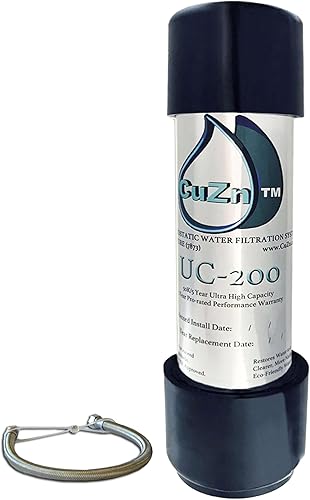
CuZn UC-200: Best for no-drill kitchens
- Inline connection to an existing faucet
- No countertop drilling
- Micro sediment membranes, KDF-55 and coconut shell carbon
- Retains dissolved minerals
The UC-200 suits kitchens where adding a second faucet would be awkward. CuZn's long service-life claim makes it worth considering if you want fewer replacement tasks.
Pros
- No additional faucet needed
- Long stated service life
- Works with kitchen or bathroom faucet setups
Cons
- Incoming water quality affects replacement timing
- Does not lower TDS
Choose the CuZn UC-200 when you want filtered water from an existing kitchen or bathroom tap without adding another faucet. Its inline connection avoids countertop drilling and keeps the sink deck clear.
The filtration media combine micro sediment membranes, KDF-55 and coconut shell carbon. CuZn claims reductions in chlorine, lead, PFAS and unwanted taste and odor.
CuZn gives a service life of up to 5 years or 50,000 gallons, depending on incoming water quality. Treat that as a replacement limit subject to water conditions, rather than a reason to ignore a change in performance.
The brand identifies NSF/ANSI 42 certified components. That component certification should not be extended to every contaminant-reduction claim made for the system.
Skip it if you want a separate drinking-water outlet or need dissolved-solids reduction. Because it feeds your existing faucet, routine cold-water use also passes through the filter, so consider how much water your household uses at that tap.
Waterdrop UA-5Y: Best for fewer replacements
- Stated 5-year filter life
- Direct connection to the kitchen faucet
- 0.5 micron activated carbon block
- No electricity needed
The UA-5Y suits households that want one filter housing and a long replacement interval. Check cabinet height first because its narrow body still needs substantial vertical room.
Pros
- Long replacement interval
- Uses the existing faucet
- 5-year prorated replacement warranty for early expiration
Cons
- Tall housing needs clearance
- Not recommended for well water
Choose the Waterdrop UA-5Y if your priority is a long replacement interval with one housing to maintain. It connects to your existing kitchen faucet and operates without electricity.
Waterdrop claims its 0.5 micron activated carbon block reduces chlorine, PFOA/PFOS, unwanted taste and odor, turbidity, rust and sand. The brand also provides a 5-year prorated replacement warranty for early expiration, which is worth reading before you rely on the long service-life promise.
Cabinet height is the main fit check. The body measures 3.9 L x 3.6 W x 16.7 H in, so a narrow floor space alone doesn't establish that it will fit.
This model suits municipal-water households that prefer fewer replacement tasks over the TSU's separate faucet and reminders. Its NSF/ANSI 372 certification concerns lead-free materials, rather than certifying all reduction claims.
Skip it for well water, which Waterdrop does not recommend, or when a low shelf blocks cartridge access. A long replacement interval won't help if servicing the housing requires dismantling nearby plumbing.
Waterdrop TSA: Best for fluoride-conscious households

- Three filters with separate service intervals
- Resin for claimed fluoride reduction
- Connects to a compatible existing faucet
- Twist-and-lock replacement design
Consider the TSA if fluoride reduction is one of your goals and you want to keep your existing faucet. Waterdrop claims its resin reduces fluoride, so confirm the reduction details match your water needs.
Pros
- Includes fluoride-reduction resin
- No additional faucet needed
- Individual filters can be replaced separately
Cons
- Several replacement dates to track
- Well water requires pre-filtration
Consider the Waterdrop TSA if fluoride reduction is part of your shopping brief and you want to keep your existing faucet. Waterdrop says its resin reduces fluoride, alongside claims for PFAS, chlorine, silt, rust and cyst reduction.
Its 3 filters provide what Waterdrop describes as 8-stage filtration. More stages also mean more maintenance dates, so this suits someone willing to track individual cartridges.
The system measures 12.9 L x 4.3 W x 12.4 H in. Check its full width against cabinet obstructions, then make sure you can reach every filter without moving the unit.
Compatibility matters with this pick. It supports specified female NPT faucet connections, while quick-connect faucet arrangements may need adapter fittings from Waterdrop.
Skip it if you want one replacement date or expect a filter to preserve the exact feel of unrestricted tap flow. Waterdrop notes that filtration slows the stream, and its well-water instructions require pre-filtration rather than direct use on an untreated supply.
Waterdrop 15UA: Best for everyday tap use

- Direct-connect cold-water setup
- Push-to-connect fittings
- Up to 24-month filter life with municipal water
- IAPMO certifications for chlorine reduction and lead-free materials
The 15UA suits a kitchen where filtered cold water should come from the main tap. It offers one replacement filter to track and a stated service interval between the annual and longer-life options.
Pros
- Uses the existing kitchen faucet
- One replacement filter to track
- Push-to-connect fittings
Cons
- Not for well water or hot water
- Tall housing needs cabinet clearance
Choose the Waterdrop 15UA for everyday filtered cold water through the main kitchen faucet. Its single replacement cartridge keeps maintenance planning simpler than a system with several independent stages.
Waterdrop identifies IAPMO certification against NSF/ANSI 42 for chlorine, taste and odor reduction and NSF/ANSI 372 for lead-free materials. The brand separately claims reductions in PFOA/PFOS, lead, heavy metals and sediment.
Its flow figure is 0.75 GPM at 60 psi. If you regularly fill large pots, consider whether that pace fits your routine instead of assuming the main faucet will behave exactly as it did without a filter.
The housing is 16.7 in tall, so give it the same vertical-clearance check as the UA-5Y. Push-to-connect fittings and adapters support common cold-water connection sizes.
Skip it for hot water or well water, or if you prefer to reserve filtration for drinking water at a separate tap. The replacement cartridge is WD-RF15, a useful detail to save with your installation date.
Waterdrop 10UB: Best for separate drinking taps

- Dedicated brushed stainless steel faucet
- Single-filter design
- Twist-and-lock filter replacement
- Designed for municipal cold water
The 10UB suits households that want a separate drinking-water faucet with one filter to maintain. Its shorter housing offers another fit option when taller single-filter systems won't clear the plumbing.
Pros
- Dedicated faucet included
- Shorter housing than the 15UA and UA-5Y
- Tool-free twist-and-lock filter changes
Cons
- Needs a suitable faucet opening
- More frequent replacement than the long-life picks
Choose the Waterdrop 10UB if you want a separate drinking-water tap with only one filter cartridge to track. Its brushed stainless steel faucet is included, and the housing is shorter than the UA-5Y and 15UA.
The body measures 3.9 L x 3.6 W x 12.3 H in, which may suit a cabinet with limited height. You still need space above the sink for the faucet and access beneath it to secure the mounting hardware.
Waterdrop identifies IAPMO certification against NSF/ANSI 42 for chlorine, taste and odor reduction and NSF/ANSI 372 for lead-free materials. The brand also claims reductions in PFOA/PFOS, heavy metals and sediment.
Use the 0.75 GPM at 60 psi system figure for planning. A faucet's maximum flow capacity is a different measurement and should not be treated as the filtered-water delivery rate.
Skip this model if you want the longest replacement interval. It uses the WD-RF10 replacement filter, with a twist-and-lock design for cartridge changes.
How do you choose the best under sink water filter?
Choose around your water concern first, followed by faucet layout, cabinet access and upkeep. Neither a small micron number nor a long service-life claim answers all those questions.
Match the filter to the substances you want to reduce
Start with your municipal water report and any known concerns about your home's plumbing. Chlorine taste, sediment, lead and dissolved salts are different problems, so don't treat one reduction claim as covering them all.
Taste improvement is a useful goal, but good-tasting water doesn't establish that every unwanted substance has been addressed. Match a specific concern to a specific reduction claim.
If a health-related contaminant drives the decision, confirm the exact model's certification scope, reduction claim and operating conditions. A broad claim such as “heavy metals” is less useful than information about the substance you actually need reduced.
Read certification claims by their scope
Lead-free construction and lead reduction mean different things. NSF/ANSI 372 concerns lead content in materials, while NSF/ANSI 42 addresses aesthetic effects such as chlorine taste and odor within the certified scope.
A certified component also does not establish certification for the complete system's every claim. This distinction matters when comparing products that describe their certifications in different ways.
Use certification details to answer a narrow question: what does the certification cover on this exact model? Don't turn a standards number into a blanket promise about water safety.
Which under sink water filter connection do you need?
Choose direct connect if you want filtered cold water from the existing faucet. Choose a dedicated faucet if you want a separate outlet for drinking and cooking water.
Direct-connect filters also handle cold water used for rinsing dishes and cleaning at that faucet. A dedicated tap lets you reserve the filter for selected uses, provided everyone in the household uses the correct tap.
Check available sink openings, faucet-hose connections and permission to alter the counter. Our filter installation walkthrough explains the basic layout decisions before you disconnect anything.
Decide whether TDS reduction is actually your goal
Choose a different treatment approach if lowering dissolved solids is a requirement. These picks retain dissolved minerals, and a TDS meter reading may remain similar after filtration.
TDS does not identify individual contaminants or tell you whether a chlorine-reduction filter is doing its job. It also doesn't measure water hardness by itself.
Don't buy one of these filters expecting it to soften hard water or eliminate mineral scale. Decide whether you want taste and targeted contaminant reduction, dissolved-solids reduction, or a separate hardness treatment before ordering.
Measure the space needed for service
Measure usable width, depth and height, then allow the clearance required for cartridge removal. An empty patch of cabinet floor may still sit beneath a drain trap or disposal that blocks service access.
Plan the tubing route without sharp bends, pinched sections or tension at the fittings. Keep the shutoff valve reachable after the filter and stored supplies are in place.
Our under sink filter and RO guide can help you compare layouts if the cabinet cannot accommodate your preferred system. Settle the physical fit before choosing on filter life alone.
Compare water delivery and replacement needs together
Treat maximum flow figures as operating-condition figures, not promises of identical performance in every kitchen. Supply pressure, restrictions and cartridge condition can affect the stream you get.
For a direct-connect filter, think about filling pots as well as drinking glasses. For a dedicated tap, consider how often several people will need water at once.
Then compare replacement part availability, the number of cartridges required and their separate intervals. A system with fewer changes can suit a busy household, while replaceable stages offer more individual tasks to track.
What should you check before installing an under sink filter?
Check the cold-water shutoff, connection type and faucet plan before opening the plumbing. Installation is easier to judge once you know those details, rather than relying on a short installation-time claim.
Inspect the valve and identify the fittings
Confirm that the cold-water valve closes fully and look for corrosion or existing leaks. A valve that won't shut off reliably needs attention before you disconnect a supply hose.
Match thread size and connection type, not just the apparent hose diameter. A threaded connection and a quick-connect faucet hose may need different adapters even when their sizes sound similar.
Lay out the parts against the instructions before starting. Don't force mismatched threads or add sealant to every joint, since connection designs have different sealing methods.
Plan the dedicated faucet opening
Check both sides of the sink or counter before committing to a faucet position. The tap needs usable space above, while its mounting hardware and tubing need clearance below.
An existing opening may help, but confirm that its size and location suit the included faucet. If drilling is needed, use a method appropriate for the counter material and get help if the work is beyond your tools or experience.
For questions about mounting or replacing a separate tap, our guide to filter and reverse osmosis faucets covers the practical faucet issues.
Flush and check the finished connections
Follow the exact model's flushing instructions before drinking the water. Flush requirements vary, so don't substitute a quick rinse for the stated procedure.
Dry the connections, restore water gradually and inspect each joint while water is running and after the faucet closes. Recheck after ordinary use, when a slow seep may become easier to spot.
Keep the manual, replacement model numbers and installation date together. A photo of the finished plumbing can also help you remember the tubing route when service is due.
How do you care for an under sink water filter?
Use a cartridge-by-cartridge schedule and follow the system's instructions for flushing, cleaning and periods away. The longest service-life number on a system is not the replacement interval for every stage.
Record dates before you forget them
Set reminders as soon as the filter goes into use. For a multi-filter system, record each cartridge's due date separately instead of labeling the whole unit with one date.
Keep replacement part numbers with those reminders so you don't reorder a similar-looking cartridge. Check that the part matches the exact system before removing the old filter.
Don't borrow a maintenance schedule from a different filtration type. If you're comparing upkeep with RO, our guide to how long reverse osmosis filters last explains why those systems also have several service intervals.
Investigate changes in flow or taste
A weaker stream can come from a loaded cartridge, a kinked tube, a partly closed valve or another restriction. Check the simple causes before assuming the entire system has failed.
A return of unwanted taste or odor deserves attention even if the calendar says a replacement isn't due. Follow the troubleshooting guidance rather than extending use solely because water still passes through.
Taste and flow are practical warning signs, but neither confirms contaminant removal. Maintain the filter within its stated limits even when the water seems unchanged.
Follow the instructions for time away
Use the model's own guidance for extended breaks, storage and restarting after a vacation. Don't apply one cartridge's storage advice to another system.
Keep the unit away from freezing conditions and protect tubing from items pushed into the cabinet. After service or a long break, complete the required flush and inspect the connections again.
Which common buying mistakes should you avoid?
Avoid choosing by stage count, maximum lifespan or a single meter reading. Each can hide a practical mismatch with your water supply or kitchen.
- Treating more stages as broader protection: Compare the actual reduction claims, since several stages can serve related purposes.
- Expecting a chlorine filter to soften water: Mineral retention means hardness-related scale may remain.
- Using a municipal-water filter on an untreated well: Source-water limits apply even when the fittings connect.
- Measuring the housing without service space: Leave access for cartridges, tubing and the shutoff valve.
- Choosing direct connect without considering total use: All cold-water use through that connection contributes to filter use.
- Buying on the longest lifespan alone: Water conditions, usage limits and individual cartridge schedules still matter.
Resolve a mismatch before buying rather than planning to work around it later. In particular, an incompatible water source or missing faucet space should remove a model from your shortlist.
Which best under sink water filter should you pick?
Pick the Waterdrop TSU if a dedicated faucet and visible maintenance reminders fit your routine. Pick the CuZn UC-200 if avoiding countertop drilling matters most, or the Waterdrop UA-5Y if you have the height and want fewer replacements.
Choose the TSA when fluoride reduction is a specific goal and you're prepared to check its claim against your needs. The 15UA suits main-tap use with one cartridge to track, while the 10UB suits a separate drinking tap with a shorter housing.
The best under sink water filter is the one that addresses your water concern and remains easy to service after installation. Eliminate unsuitable water sources and cabinet layouts first, then make the final choice around faucet use and maintenance.
For dissolved-solids reduction, use our guide to under sink filters and reverse osmosis to choose the treatment type. If RO is already your decision, continue to the best under sink reverse osmosis systems.
Our top 3 picks at a glance
-
1
-
2
-
3
Frequently asked questions
Do under sink water filters reduce TDS?
These picks retain dissolved minerals and are not intended to lower TDS. A TDS meter measures the amount of dissolved solids, but it cannot identify individual contaminants or confirm their removal.
If lowering dissolved solids is your goal, compare reverse osmosis systems with reduction claims that match your water concerns.
Do under sink water filters need a separate faucet?
No, direct-connect models send filtered cold water through your existing faucet. The TSU and 10UB instead include dedicated taps that need suitable openings in the sink or counter.
Choose the layout before comparing filter life, since faucet installation can determine which systems your kitchen can accommodate.
Can I use an under sink filter with well water?
Choose treatment around a well-water analysis rather than assuming a municipal-water filter will suit your supply. Waterdrop excludes well water for several picks here and requires pre-filtration for the TSA.
Pre-filtration alone does not establish that a system addresses every concern in your well water.
How often do under sink water filters need replacement?
Follow the interval for your exact cartridge, along with any water-quality or usage limits in its instructions. A multi-filter system can have several replacement dates even when its longest-lasting stage lasts years.
Record installation dates and replacement part numbers so you can maintain each stage on its own schedule.
Are under sink water filters hard to install?
A direct-connect system can be a manageable DIY job when the shutoff valve works and the fittings match. Adding a dedicated faucet takes more planning, especially if the counter needs drilling.
Use our under sink water filter installation guide to check connections, access and installation steps before starting.