Under Sink Water Filter vs Reverse Osmosis: Which Is Better? (October 2026)
The under sink water filter vs reverse osmosis choice comes down to your treatment needs: choose ultrafiltration to retain minerals without wastewater, or RO to reduce dissolved substances. Both fit under the sink, so match the filtration method to your water report before comparing kitchen fit.
On this page (9 sections)
- Under sink water filter vs reverse osmosis: what is the main difference?
- What should you learn about your water before buying?
- Which system uses less water?
- How do installation and cabinet space compare?
- How much drinking water do you need at once?
- How often will you replace filters?
- Which of these systems fits your household?
- What common mistakes should you avoid?
- What should you choose in an under sink water filter vs reverse osmosis comparison?
For under sink water filter vs reverse osmosis, choose a non-RO filter when its reduction claims match your water concerns, or choose RO when you need to reduce dissolved substances. Both can sit beneath your kitchen sink.
The real choice is the filtration method, not the installation location. A filter that improves chlorine taste can be enough for one household, while another needs a membrane suited to a specific dissolved contaminant.
Here, the Waterdrop TSU represents ultrafiltration, while the iSpring RCC7AK-BN and APEC ROES-50 represent tank-based RO. Start with your water report, then compare plumbing, cabinet fit and care.

Under sink water filter vs reverse osmosis: what is the main difference?
RO reduces dissolved substances; ultrafiltration generally leaves dissolved minerals in place. “Under sink water filter” is a broad label that includes carbon filters, ultrafiltration systems and reverse osmosis systems.
Carbon media commonly help with chlorine taste and odor. Ultrafiltration adds a membrane that traps particles larger than its pores, while an RO membrane also separates many dissolved substances from the drinking-water stream.
A small pore number doesn't establish that a system handles every water concern. The complete system, its filter media and its verified reduction claims matter more than comparing membrane numbers alone.
How should you compare under sink filters and reverse osmosis?
Match the system to the substance you need to reduce. A chlorine taste complaint, an identified lead concern and high dissolved mineral content are different buying problems.
TDS means total dissolved solids, a broad measure of dissolved material. It doesn't identify which substances are present, and a low reading doesn't prove water is safe.
Likewise, an unchanged TDS reading doesn't mean a carbon or ultrafiltration filter has failed. These methods can reduce certain substances while leaving dissolved minerals behind.
Use the guide to choosing a reverse osmosis system if your water needs point toward RO and you need help comparing layouts.
What should you learn about your water before buying?
Identify your water source and specific concerns before choosing a filter. Municipal water users can start with their utility's water quality report, while private-well users need a laboratory analysis suited to their location and supply.
A utility report describes the public supply, but conditions in your home's plumbing can also matter. If your concern involves a particular tap or older plumbing, arrange a sample from that location.
Write down the substances you want to reduce, then look for claims and certification coverage that name them. A long contaminant list or a high overall removal percentage is less useful than evidence for your actual concern.
Certification standards also cover different things. Lead-content requirements for plumbing materials and contaminant-reduction performance are separate questions, so don't treat every certification mark as proof of the same protection.
Neither category is a whole-house softener. An under sink system treats water at that drinking-water outlet, so it won't solve scale at every shower, appliance or faucet.
For well water, confirm any need for sediment, iron, hardness or microbial treatment before selecting a kitchen unit. Don't assume either RO model here can handle untreated well water without further checks.
Which system uses less water?
Ultrafiltration avoids the reject-water stream that RO needs. The Waterdrop TSU produces no wastewater, making it a useful choice when its filtration matches your needs and conserving water is a priority.
RO sends part of the incoming water across the membrane toward the drain. That stream carries away rejected substances and is part of normal operation.
Compare an RO system's water-use information under conditions close to your home. Incoming pressure, temperature and water quality can affect output and efficiency, so don't assume all RO designs use the same amount.
A tank stores finished water for later use; it doesn't remove the need for reject water. Plan for both drinking-water demand and the drain connection.
If wastewater is your deciding concern, first establish whether you need RO at all. Choosing a different method only helps if it still addresses the substances you need to reduce.
How do installation and cabinet space compare?
A non-RO system usually needs fewer plumbing connections, but every model still needs a workable faucet location and service space. For tank-based RO, measure the filter assembly and storage tank as separate parts.
The TSU measures 4.68 in wide, 13.97 in high and 14.81 in long. Its narrow body helps in crowded cabinets, but leave room to reach and remove its filters.
Measure around the disposal, shutoff valves, shelves and cabinet door hinges. A unit that fits inside the cabinet may still be awkward to service if another fixture blocks its access.
All 3 products here use separate drinking-water faucets. Plan the location before ordering, including clearance above the counter and access around the sink.
The TSU requires countertop drilling, so consider the counter material and who will make the opening. Renters should settle permission for plumbing changes and drilling before buying equipment.
RO also needs a suitable drain connection and tubing routes that won't kink or get crushed by stored items. Check incoming water pressure against the selected model's requirements rather than assuming every kitchen supply is suitable.
The under sink water filter and RO system guide helps compare layouts. For the work itself, use our guides to installing an under sink water filter and installing a reverse osmosis system alongside the model's manual.
How much drinking water do you need at once?
Match the system to your busiest refill period, not just your daily total. Filling a glass and filling several large bottles before school place different demands on a kitchen filter.
For tank-based RO, stored water supplies the faucet while the membrane gradually makes more. After a large draw, recovery time matters more than the headline daily production number.
A gallons-per-day figure describes production over time under specified conditions. It isn't the amount immediately available from the faucet or the usable capacity of the storage tank.
The Waterdrop TSU has a maximum flow of 1.05 GPM. Actual flow can depend on supply conditions and filter condition, so consider how often you fill pitchers, cooking pots or reusable bottles.
If RO meets your treatment needs but a storage tank won't fit, compare tankless vs tank reverse osmosis before abandoning the category. Check each alternative's plumbing and power requirements separately.
How often will you replace filters?
Plan care by filter stage, not by a single system lifespan. A long-lived membrane doesn't mean the sediment and carbon filters can stay in place just as long.
Waterdrop gives the TSU these intervals:
- PP filter: 6 months.
- CT filter: 12 months.
- UF filter: 24 months.
Its panel has 4 reminder lights. Treat reminders as maintenance prompts, then follow the instructions for the correct cartridge and reset procedure.
APEC recommends replacement every 6–24 months depending on incoming water quality. iSpring offers replacement sets for 6-month, 1-year, 2-year and 3-year maintenance intervals.
Those set names aren't permission to leave every filter unchanged for the full period. Keep a record of installation dates and the next service date for each stage.
Before buying, check replacement availability and the ongoing expense of the correct cartridges. Our reverse osmosis system cost guide covers the spending categories to include beyond the initial system.
During service, follow the shutoff, pressure-release and sanitation steps in the manual. After reconnecting parts, check for leaks with the faucet running and again after the system has returned to normal operation.
Use the guide to how long reverse osmosis filters last to build a maintenance calendar rather than waiting for taste or flow to change.
Which of these systems fits your household?
Choose the product that meets your water needs and fits your kitchen's service space. The differences below matter more than choosing the highest score by itself.
Who should choose the iSpring RCC7AK-BN?
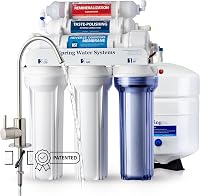
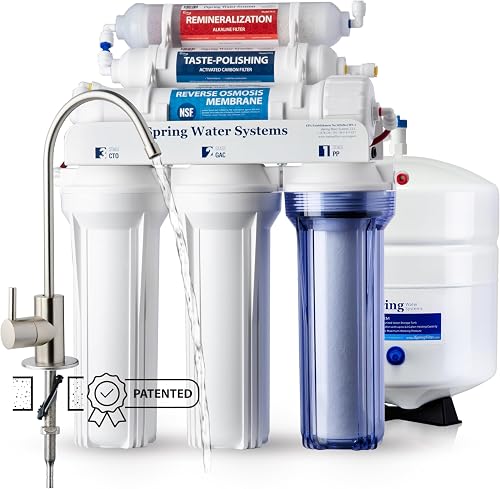
Choose the iSpring for RO with a remineralization stage, especially if you prefer that approach to drinking-water taste. Its 6-stage design includes a storage tank and a brushed nickel faucet.
iSpring states that the whole system is NSF/ANSI 58 certified and claims 93–98% TDS reduction. Check certification coverage for your target substance rather than treating the standard number as a blanket promise.
The faucet fastener tightens from above the counter, reducing the need to reach beneath the sink for that step. Quick-fitting connections and color-coordinated tubing help with the remaining setup.
The transparent first-stage housing lets you see sediment buildup, but appearance doesn't replace scheduled maintenance. Dissolved substances and exhausted filter media aren't reliably judged by sight.
Skip this model if a tank crowds out the access you need for plumbing or filter changes. It also adds more stages to maintain than a household seeking only a simple taste improvement may need.
Who should consider the APEC ROES-50?
Choose the APEC for a conventional RO layout when you want a tank, faucet, filter set and installation kit together. Its 5-stage system suits buyers who want dissolved-solids reduction without choosing a model around an added mineral stage.
Rated production is 50 gallons per day. Size your expectations around stored water and recovery between large draws rather than treating that figure as faucet speed.
Quick connection fittings and colored tubing help keep installation and later service organized. Labeling or photographing your tubing routes before maintenance can also make reconnection easier.
Skip it if your cabinet can't accommodate a tank with access around it. If your only concern is chlorine taste and a suitable non-RO filter addresses it, compare that simpler route before committing to RO plumbing.
Who should choose the Waterdrop TSU?
Choose the TSU for municipal water when you want mineral retention without an RO drain connection. Its 0.01 micron ultrafiltration membrane works with carbon media, and Waterdrop says it reduces chlorine, PFAS, taste, odor and heavy metals.
This is a practical fit for a household that wants a dedicated drinking-water outlet while preserving existing dissolved minerals. It requires no power for filtration and avoids a storage tank.
Skip it for well water or any treatment goal that requires TDS reduction. Also skip it if you can't accommodate the required faucet drilling.
Keeping minerals isn't proof that the water is healthier, just as removing them isn't proof that RO is necessary. Let your water concerns decide the treatment, then use taste and convenience to choose among suitable options.
What common mistakes should you avoid?
Avoid buying by TDS, filter-stage count or cabinet dimensions alone. Each leaves out information that can change whether a system works for your home.
- Using TDS as a safety verdict: A meter doesn't identify individual contaminants or replace a water analysis.
- Assuming more stages always means better filtration: An extra stage may serve a taste preference rather than address another water concern.
- Measuring only the filter body: Tanks, tubing bends and cartridge-removal clearance need space too.
- Treating faucet installation as a minor detail: Countertop drilling can be the step that calls for outside help.
- Comparing daily output with faucet flow: Production capacity and water available during a large draw are different measures.
- Waiting for bad taste before maintenance: Some service needs won't produce an obvious taste change.
At first use, complete the specified flushing and tank-fill steps before drinking the water. After a long absence, follow the manual's restart instructions rather than assuming the first glass is ready to use.
What should you choose in an under sink water filter vs reverse osmosis comparison?
Pick the treatment first, then choose the hardware you can install and maintain. That decision rule makes the under sink water filter vs reverse osmosis choice much clearer.
Choose the Waterdrop TSU for suitable municipal water when retaining minerals and avoiding wastewater meet your priorities. Choose the iSpring RCC7AK-BN for RO with remineralization, or the APEC ROES-50 for a conventional 5-stage RO setup.
Before ordering, confirm 3 things: the system addresses your water concern, the complete installation fits, and replacement cartridges are practical to keep on schedule. A higher score doesn't outweigh a mismatch on any of those points.
For the next step, use our best under sink water filters to compare non-RO choices, or our best under sink reverse osmosis systems once your water needs point toward RO.
Frequently asked questions
Does an under sink water filter reduce TDS?
Only some do: under sink describes the location, while the filtration method determines TDS reduction. Reverse osmosis reduces dissolved substances, but the Waterdrop TSU ultrafiltration system leaves TDS in the water.
Use your water report to identify treatment needs rather than choosing a filter by location or TDS reading alone.
Does reverse osmosis waste water?
Reverse osmosis sends some incoming water to the drain to carry away rejected substances. The amount depends on the system and operating conditions, so compare water-use information before buying.
Ultrafiltration such as the Waterdrop TSU produces no wastewater, making it a better fit when dissolved-solids reduction isn't needed.
Which is easier to install, an under sink filter or RO?
A non-RO filter usually needs fewer plumbing connections because it doesn't require an RO drain connection or storage tank. Faucet work can still be significant: the Waterdrop TSU requires countertop drilling for its separate faucet.
Check the manual, counter material, cabinet clearance and existing plumbing before deciding on a DIY installation.
Which system is better for well water?
Choose well-water treatment from a laboratory water analysis, not from this category comparison alone. The Waterdrop TSU is not suitable for well water, and either RO model needs compatibility checks for your source water.
Sediment, hardness, iron or microbial concerns may call for treatment before water reaches an RO system.
Will reverse osmosis remove healthy minerals?
Reverse osmosis reduces dissolved minerals along with other dissolved substances. The iSpring RCC7AK-BN adds a remineralization stage, while the Waterdrop TSU retains minerals already present in the water.
Choose the treatment your water needs first, then consider taste preferences; a mineral stage doesn't replace a balanced diet or establish water safety.