How to Choose a Reverse Osmosis System for Your Kitchen
Here's how to choose a reverse osmosis system: match documented contaminant reductions to your water, then check cabinet space, water pressure and filter upkeep. Choose tank or tankless based on how you draw water and whether you have room for a reservoir and access to power.
On this page (9 sections)
- How to choose a reverse osmosis system for your water
- Should you choose a tank or tankless system?
- Will the system fit under your sink?
- Do you want a remineralization stage?
- How much maintenance can you manage?
- Which reverse osmosis systems fit different kitchens?
- What installation details should you check?
- Which buying mistakes should you avoid?
- How should you make the final reverse osmosis choice?
Here's how to choose a reverse osmosis system: match its documented contaminant reductions to your water, then check fit, water pressure, delivery and upkeep. The right choice must work with both your water supply and the way you use your kitchen.
Start with your water report and cabinet measurements before comparing stage counts or daily output. These first checks can rule out a system before you spend time comparing extra features.
For a wider shortlist, see our best under-sink reverse osmosis systems. The steps below explain how to narrow that shortlist to a setup you can install, use and maintain.
How to choose a reverse osmosis system for your water
Choose a system with documented reductions for the substances you want to address. A broad impurity-removal percentage doesn't replace information about a specific contaminant.
For public water, start with your utility's water quality report. If your concern involves household plumbing, such as lead from older pipes, arrange analysis at your tap because a utility report doesn't describe every home's plumbing.
For private well water, get a current water analysis before selecting treatment. Sediment, hardness, iron and microbial concerns may call for treatment before water reaches an under-sink RO unit.
Don't assume a kitchen RO system can make any untreated well supply suitable for drinking. Our guide to reverse osmosis systems for well water explains the extra checks involved.
Read certification claims by standard and scope. Certification for lead-free materials addresses materials in the system; it doesn't establish lead reduction in the water.
Waterdrop identifies NSF/ANSI 58 certification for TDS reduction, NSF/ANSI 372 for lead-free material, and NSF 42 for chlorine, taste and odor reduction on the G3P600. iSpring identifies full-system NSF/ANSI 58 certification for the RCC7AK-BN.
Keep those scopes separate from other reduction claims a brand makes. If a particular contaminant drives your choice, confirm that exact model's documented performance for it before buying.
If your main concern is chlorine taste, also compare a simpler filter. Our under-sink filter vs. reverse osmosis comparison explains when the extra membrane, drain connection and upkeep are useful.
Should you choose a tank or tankless system?
Choose a tank system for stored filtered water, or tankless when removing the separate reservoir helps your cabinet layout. Check power needs and water delivery before deciding.
A tank system makes water gradually and stores it for later use. This suits households that draw several glasses or fill a cooking pot at once, provided the tank has enough usable water.
Once the stored supply runs low, the membrane needs time to replenish it. A tank's nominal volume also isn't the same as the amount of water you can draw, because part of the tank holds pressurized air.
Tankless systems produce water as you draw it, so their faucet flow matters during longer fills. They remove the separate reservoir, but the main unit still needs room for tubing and service.
The Waterdrop G3P600 requires under-sink electricity. The iSpring RCC7AK-BN operates without electricity, and the APEC ROES-PH75 uses water pressure.
If keeping water available during an outage matters, check how your chosen system delivers water without power. A stored supply is finite, and homes with electric well pumps also depend on the water supply continuing to work.
Our tankless vs. tank reverse osmosis guide compares these layouts in more detail.
How to choose a reverse osmosis system by output and flow
Compare daily production, faucet flow and stored volume separately. They answer different questions about how a system will serve your household.
The APEC ROES-50 is rated for 50 gallons per day. The iSpring RCC7AK-BN and APEC ROES-PH75 are each rated for 75 gallons per day, while the Waterdrop G3P600 is rated for 600 gallons per day.
These figures describe production under specified conditions, rather than the amount instantly available at the faucet. Feed-water pressure, temperature and dissolved solids can affect actual output.
Estimate drinking water, coffee, cooking and bottle fills on a busy day. Then consider your largest single draw, such as filling several bottles before leaving home, rather than choosing from household size alone.
A larger daily rating won't fix an unsuitable installation or poor feed-water conditions. For tank models, ask about usable storage and refill time; for tankless models, compare faucet flow with the size of containers you fill.
Will the system fit under your sink?
Measure usable space and service clearance, not just the outside dimensions of the filter unit. Include the tank, tubing bends and room to reach shutoff valves.
Record cabinet width, depth and height after accounting for the disposal, drain trap, drawers and door hinges. A cardboard footprint can help you see whether the unit blocks other plumbing.
For the ROES-50, APEC gives differing main-unit dimensions, so confirm the footprint if clearance is tight. Its separate tank measures 11 in wide by 15 in high.
The iSpring RCC7AK-BN main unit measures 15.5 x 16 x 18 in. Allow additional room for its included tank and access to the filter housings.
The Waterdrop G3P600 measures 18.12 x 5.67 x 17.72 in. Its narrow width helps only if the cabinet also accommodates its full depth, height and cartridge access.
The APEC ROES-PH75 main unit measures 15.5 x 5.25 x 17.5 in, with a separate tank measuring 11 in wide by 15 in high. Plan both footprints before moving cleaning supplies back into the cabinet.
Don't wedge any system against a disposal or bury its shutoff behind stored items. You should be able to inspect fittings and service filters without dismantling the cabinet.
Do you want a remineralization stage?
Choose remineralization for a preference for added minerals and taste. It isn't required for the RO membrane to work, and higher pH shouldn't be the reason to expect a health benefit.
The iSpring RCC7AK-BN has a mineral AK stage that iSpring describes as adding minerals and adjusting pH. The APEC ROES-PH75 uses a calcium mineral cartridge after filtration.
The APEC ROES-50 has no added mineral stage. It suits buyers who want RO filtration without another cartridge devoted to mineral addition.
If you're unsure about taste, avoid assuming that more stages automatically means better water for you. Each stage should have a purpose you want, plus a replacement schedule you're willing to follow.
Mineral addition can also raise the final TDS reading. Compare readings at the points described in the system's instructions rather than judging a mineral-equipped system against a different design.
How much maintenance can you manage?
Choose a system whose replacement filters and service steps fit your routine. Identify the correct cartridges and read the maintenance instructions before committing to a model.
APEC recommends ROES-50 filter replacement every 6 to 24 months, depending on incoming water quality. That range doesn't mean every stage lasts the same amount of time.
iSpring offers RCC7AK-BN replacement sets for 6-month, 1-year, 2-year and 3-year maintenance. Match each set to the stages due for replacement rather than treating the set name as every cartridge's lifespan.
The G3P600 has a filter-life tracker and cartridges Waterdrop says can be changed without tools. Its display helps with reminders, while access to compatible replacement cartridges remains part of the buying decision.
Keep a simple record of installation dates, cartridge part numbers and the next service date. Follow the manual's sanitation and flushing directions when replacing filters or returning the system to use after an extended break.
A visible sediment filter can show buildup, but appearance doesn't reveal the condition of every stage. Likewise, a TDS meter measures dissolved solids and cannot confirm that water is free of every contaminant.
Our reverse osmosis filter life guide explains why replacement schedules differ. Include the membrane and any mineral cartridge in your upkeep plan, not just the first filters.
Which reverse osmosis systems fit different kitchens?
Choose among these 4 systems by storage layout, mineral preference and service needs. Each fits a different buying situation, so use the reasons to buy and skip below to narrow your choice.
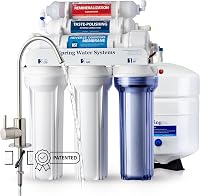
APEC ROES-50: for a conventional setup without added minerals
Choose the APEC ROES-50 if you want a traditional tank layout and don't want a mineral cartridge. Its 5-stage design suits buyers who want to keep that extra stage out of their maintenance plan.
The kit includes a filter set, brushed nickel faucet, tank and installation supplies. Quick-connection fittings and colored tubing help you follow the connection layout during setup and later service.
Skip it if added minerals are a priority, or if a separate tank would block cabinet access. Its daily rating also deserves a closer look if your routine includes large, repeated draws with little refill time.
Before ordering, map out the tank and filter positions together. For alternatives that use a different filtration approach, browse our best under-sink water filters.
iSpring RCC7AK-BN: for mineral-water preferences and awkward faucet access
Choose the iSpring RCC7AK-BN if you want a mineral stage and a faucet fastener you can secure from above the counter. That installation feature is useful where reaching behind a deep sink is difficult.
The system includes a brushed nickel faucet and storage tank. Its transparent first-stage housing lets you inspect sediment buildup, while quick-fitting connections and installation videos support the setup process.
Skip it if you don't want mineral addition or can't accommodate the unit and tank. The easier faucet fastener doesn't remove the need to connect the feed water, drain and tubing below the sink.
The clear housing is a service aid, not a reason to extend filter intervals. Use the written schedule for carbon filters, the membrane and the mineral stage.
Waterdrop G3P600: for cabinets where a separate tank is the obstacle
Choose the Waterdrop G3P600 if removing a separate storage tank solves your space problem and you have a suitable outlet. Its smart faucet also suits buyers who want filter reminders near the point of use.
The faucet displays TDS and filter-life information. Waterdrop gives a filtered-water-to-drain-water ratio of 2:1, meaning 2 cups of filtered water for each cup sent to the drain.
Compare ratios in that same direction when weighing water use. Reversing “filtered to drain” and “drain to filtered” makes two systems look more alike than they are.
Skip it if you lack under-sink power or the cabinet can't provide cartridge access. Choose it for the layout and service features you need, rather than assuming its daily rating equals instant delivery at any flow.
APEC ROES-PH75: for buyers who specifically want added calcium
Choose the APEC ROES-PH75 if you want a tank system with a calcium mineral stage. It gives you a clear reason to choose it over a system without mineral addition.
The included kit contains the tank, faucet, filter set, tubing, drain saddle, feed-water adapter and wrenches. It uses water pressure, making outlet availability less of a deciding factor.
Skip it if you prefer water without added minerals or want to avoid servicing a mineral cartridge. It also needs room for both the main unit and storage tank.
APEC specifies a maximum feed-water TDS of 2,000 ppm. Check that limit along with pressure and other feed-water requirements before choosing it for a challenging supply.
What installation details should you check?
Confirm the cold-water connection, drain route, faucet opening and operating requirements before buying. These determine whether the job fits your kitchen and your plumbing skills.
Both APEC models specify a feed-water pressure range of 40 to 85 psi. Confirm the permitted range for the iSpring and Waterdrop models in their installation instructions rather than treating a single pressure figure as a full range.
If pressure is low, establish the cause and check the manufacturer's approved options. Our reverse osmosis booster pump guide explains when a pump may help.
Check whether an existing sink opening can accept the RO faucet. The G3P600 calls for a 1 in faucet opening and a separate hole for its drain connection.
Read the drain instructions before drilling, especially around a disposal or unusual plumbing. If you rent, confirm permission for plumbing changes or new holes before choosing a permanently connected system.
During setup, keep tubing ends clean, make square cuts where required and seat connections as directed. Avoid tight bends, and leave enough access to inspect each fitting after the water is turned on.
Follow the startup flushing procedure before drinking the water. Check connections during initial operation and again after the system has run, using the manual's sequence.
Our reverse osmosis installation guide covers preparation and the main steps. Bring in a qualified installer if the job requires work beyond your skills.
Which buying mistakes should you avoid?
Avoid choosing by stage count, daily output or a low TDS reading alone. None of those replaces matching the system to your water and installation.
- Buying before measuring: Include the tank and service space, not just the filter unit.
- Ignoring drain water: Compare ratios with the same units and direction, then consider how much filtered water you'll use.
- Overlooking repeat expenses: Account for replacement filters, membranes, mineral cartridges and any installation work.
- Assuming extra stages solve every concern: Check what each stage does and which reductions are documented.
- Skipping startup care: Complete the required flushing and keep service dates so the system remains maintainable.
Also avoid connecting extra outlets, such as a refrigerator, without checking compatibility and pressure needs. A connection that physically fits may still require an approved kit or a different arrangement.
How should you make the final reverse osmosis choice?
The final step in choosing a reverse osmosis system is to eliminate models that fail your water, fit or operating requirements. Then choose the remaining model whose layout and upkeep best match your routine.
Pick the APEC ROES-50 for a conventional tank setup without mineral addition. Choose the iSpring RCC7AK-BN if you want its mineral stage and easier access to the faucet fastener.
Choose the Waterdrop G3P600 when a separate tank is the cabinet obstacle and power is available. Pick the APEC ROES-PH75 when added calcium is a feature you specifically want.
Before ordering, write down the filter part numbers and confirm the startup steps. If you're still deciding whether RO solves enough of a problem in your kitchen, read is a reverse osmosis system worth it?.
Frequently asked questions
How do I choose a reverse osmosis system?
Choose a reverse osmosis system by matching documented contaminant reductions to your water report, then checking installation and maintenance needs. Measure the cabinet, allow space for a tank if needed, confirm water pressure and power requirements, and identify replacement filters before buying.
Compare daily output separately from faucet flow.
Is a tankless or tank reverse osmosis system better?
A tank system suits buyers who want stored filtered water and have room for a reservoir. Tankless suits kitchens where removing that reservoir helps with storage, provided the unit and service space fit.
Check electricity requirements and faucet flow, since a high daily production figure doesn't describe every use.
Do I need remineralization in a reverse osmosis system?
You don't need remineralization for reverse osmosis to work. Choose it if you prefer water with minerals added after filtration, while allowing for another cartridge to maintain.
The APEC ROES-PH75 adds calcium, and the iSpring RCC7AK-BN uses a mineral AK stage; neither feature should drive an expected health benefit.
What should I check before installing an under-sink RO system?
Check usable cabinet space, the cold-water connection, drain connection, faucet opening and any required outlet. Include clearance for cartridge removal and access to shutoff valves.
Confirm feed-water pressure and other operating limits in the exact model's instructions, then decide whether the plumbing and drilling suit your skills.
How often do reverse osmosis filters need replacing?
Replace filters on the schedule for the exact model and filter stage, adjusted as its instructions require for incoming water quality. Sediment filters, carbon filters, membranes and mineral cartridges may have different intervals.
Record installation dates, keep the correct replacement part numbers, and follow flushing and sanitation directions during service.