Tankless vs Tank Reverse Osmosis: Which Is Better? (October 2026)
For tankless vs tank reverse osmosis, choose tankless to free cabinet space or the iSpring tank system for use without electricity. Match the system to your largest water draw, cabinet layout and filter-care needs.
On this page (12 sections)
- Tankless vs tank reverse osmosis: which should you choose?
- How do tank storage and tankless flow differ?
- Which design fits your cabinet and electrical setup?
- Which filtration features should decide your choice?
- Does tankless RO send less water down the drain?
- Who should buy the iSpring RCC7AK-BN?
- Who should buy the Waterdrop G3P600?
- Who should buy the Waterdrop G2P600?
- What should you check before installation?
- How much care does each design need?
- What mistakes lead to the wrong RO purchase?
- Tankless vs tank reverse osmosis: what is the final choice?
For tankless vs tank reverse osmosis, choose tankless when cabinet space matters most and power is available, or a tank system when you want a stored reserve and a model that works without electricity.
The main difference is how water reaches your glass. A tank system filters water into a reservoir between uses; a tankless system produces filtered water as you draw it.
Neither design wins every kitchen. Your largest water draw, available cabinet space and willingness to maintain the system matter more than choosing the highest daily capacity.

Tankless vs tank reverse osmosis: which should you choose?
Choose tankless for space savings and on-demand production; choose a tank system when its stored supply and power requirements fit your kitchen better. Then compare the exact models for flow, filtration claims and upkeep.
A tank can serve several small drinks from water prepared earlier. Once you draw down that reserve, the system needs time to replace it.
Tankless avoids that refill cycle for a separate reservoir, but every glass depends on the unit's current production. A large daily capacity doesn't mean a large pitcher fills instantly.
Which tankless vs tank RO setup fits your routine?
Start with your busiest 15 minutes of water use, rather than your household size alone. Filling 4 bottles before school creates a different demand from pouring individual glasses throughout the day.
For a tank model, check usable stored water rather than relying only on the tank's nominal size. Part of a pressure tank's interior holds air, so its total size isn't the amount you can dispense.
For tankless, look at faucet output and estimate how long your largest container will take. If you want more choices after working out your needs, compare the best under-sink reverse osmosis systems.
How do tank storage and tankless flow differ?
A tank provides a reserve, while tankless flow depends on water being filtered during use. Compare stored volume and refill time for one design, and dispensing speed for the other.
The iSpring RCC7AK-BN has a 75 GPD production capacity. That describes water production over a day under specified conditions, rather than the speed at which its full tank dispenses.
Both Waterdrop models have a 600 GPD capacity. That higher figure is useful for comparing production, but it doesn't mean either faucet delivers hundreds of gallons in a short sitting.
Waterdrop gives the G3P600 a maximum flow of 0.42 gallons per minute and says it fills an 8-ounce cup in 8 seconds. At that stated flow, a gallon would take about 2.4 minutes.
Waterdrop says the G2P600 fills a 200 ml cup in 8 seconds. Those cup claims use different volumes, so don't read them as equal flow rates.
Incoming pressure, water temperature and filter condition can affect RO production. A tank buffers small draws, but frequent large draws can expose a slow refill rate.
Which design fits your cabinet and electrical setup?
Measure around the plumbing and confirm power before choosing a design. A tankless body may fit where a reservoir won't, but its height, tubing and service access still count.
The G3P600 measures 18.12 x 5.67 x 17.72 inches. The G2P600 measures 17.3 x 5.9 x 14 inches, making it worth considering beneath a low shelf.
Cut a cardboard footprint for each candidate and place it inside the cabinet. Check door hinges, the disposal, drain pipes and the path needed to remove filters.
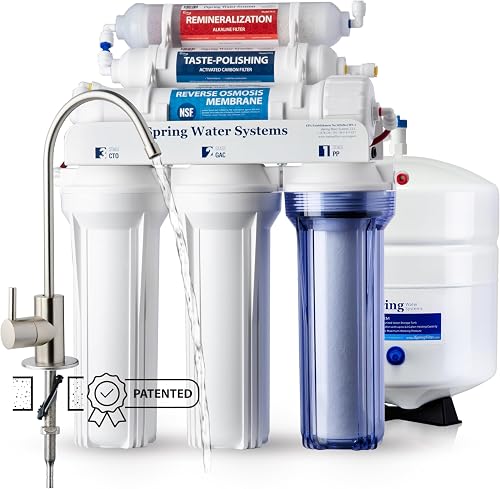
For a tank system, map the filtration assembly and separate reservoir. Don't assume a single set of system dimensions represents the entire installed layout.
The iSpring operates without electricity, while both Waterdrop models require it. Check whether an existing disposal outlet has a continuously powered receptacle; an outlet controlled entirely by a wall switch can interrupt operation.
If power outages are a regular concern, the iSpring removes dependence on an electrical connection, provided incoming water pressure remains available. A tank's presence alone doesn't guarantee that every RO model works without power.
The best tankless reverse osmosis systems guide covers more options if neither Waterdrop body fits your cabinet.
Which filtration features should decide your choice?
Choose filtration around the substances you want to reduce, then consider reminders and mineral stages. Tank design and stage count don't establish the scope of contaminant reduction.
Start with your water utility's report or a suitable source-water analysis. If you use well water, confirm that the full treatment setup addresses its needs before treating an under-sink RO unit as the only step.
iSpring identifies the RCC7AK-BN as NSF/ANSI 58 certified as a complete system. Its 6-stage design includes a mineral AK stage, which adds minerals after RO filtration.
That mineral stage suits buyers who prefer remineralized water. It isn't a reason to promise health benefits or assume a particular taste for every household.
Waterdrop identifies the G3P600 as certified to NSF/ANSI 58 for TDS reduction, NSF/ANSI 372 for lead-free materials, and NSF 42 for chlorine, taste and odor reduction. Its smart faucet displays TDS and filter life.
The G2P600 has NSF/ANSI 372 certification for lead-free materials. Lead-free materials certification isn't a lead-reduction claim, so buyers targeting a specific contaminant should confirm the relevant reduction claim before choosing it.
A TDS display measures dissolved solids rather than identifying individual substances. Use it as an operating aid, not proof that water is safe or that every filter is still effective.
Does tankless RO send less water down the drain?
Compare pure-to-drain ratios, not the presence of a tank. Waterdrop states a 2:1 pure-to-drain ratio for both models here.
That means 2 cups of filtered water for each cup sent to the drain. It doesn't mean the system uses only 1 cup of incoming water to make 2 cups of drinking water.
Confirm the iSpring's drain ratio before comparing water use between these specific options. A fair comparison needs the same information for each model.
Actual use can also include startup flushing and maintenance flushes. Follow those instructions rather than skipping them to reduce drain water.
Focus on the water your household will actually drink or use for cooking. Choosing more production capacity than you need doesn't, by itself, improve efficiency.
Who should buy the iSpring RCC7AK-BN?
Buy the iSpring for a kitchen without a suitable outlet, especially if you also want a mineral stage. Skip it when cabinet space is too tight for a separate reservoir.
Its top-mounted faucet fastener lets you secure the faucet from above the counter. That feature helps when access behind the sink is cramped, although the water and drain connections still require work below.
The transparent first-stage housing gives you a view of sediment buildup. It provides a useful visual check, but it can't show the condition of the membrane or every other filter.
This model suits a household that takes smaller draws and gives the reservoir time to refill between them. If your routine involves draining several large containers in succession, confirm usable tank volume and refill expectations first.
Who should buy the Waterdrop G3P600?
Buy the G3P600 for a tankless setup with information at the faucet. Skip it if your cabinet lacks suitable power or its height blocks a shelf or plumbing.
The display puts filter-life information where you pour water, which suits people who won't regularly inspect a unit beneath the sink. Its TDS reading can also help you notice changes that deserve a closer check.
The filters rotate out without tools. Leave the removal path open rather than packing cleaning supplies tightly against the system.
This is the stronger fit of the 2 Waterdrop options here for buyers who value both the faucet display and its stated reduction certifications. Choose those features deliberately rather than treating its higher score as a reason to ignore fit.
Who should buy the Waterdrop G2P600?
Choose the G2P600 when lower cabinet height matters and you want filter reminders. Skip it if your incoming water exceeds its supported 500 ppm TDS maximum.
Its shorter body makes it a useful candidate under a shelf, but the cabinet must still allow tubing and filter access. Measure the complete service area before deciding it fits.
The twist-and-pull filters reduce the need to work with tools during replacement. Keep compatible replacements in your maintenance plan rather than assuming cartridges from another Waterdrop model will fit.
Buyers concerned about a particular contaminant should resolve the certification question before choosing this model. Its materials certification serves a different purpose from proof of a specific substance's reduction.
What should you check before installation?
Plan the faucet, cold-water connection, drain and service access before opening the system. For tankless models, add the electrical connection to that plan.
Confirm that an existing faucet opening is suitable and that you have permission to make any required changes. Renters should settle drilling and plumbing changes before choosing a permanently installed system.
Waterdrop specifies a 1-inch faucet opening and a separate drain connection hole for the G3P600. The drain hole is a plumbing connection, not a second drinking-water faucet opening in the countertop.
Check the sink material before arranging new drilling. Stone countertops and unfamiliar plumbing can make professional help the better choice.
Route tubing without sharp bends, cuts or tension at the fittings. Keep shutoff valves reachable so you can stop the water quickly during maintenance.
Follow the manual's flushing and, for a tank model, fill-and-drain steps before drinking the water. Check each connection during startup and again after the system has operated.
Our reverse osmosis installation guide explains the setup sequence. For help deciding who should do the work, read the reverse osmosis installation cost guide.
How much care does each design need?
Both designs need timely filter changes, clean handling and leak checks. Tankless removes the separate reservoir, but it doesn't remove the need for maintenance.
Record the installation date and each cartridge change. Use the manual's schedule alongside water use, source-water conditions and any filter-life reminders.
iSpring offers F4AK, F9K, F19K75 and F28K75 replacement sets labeled for 6 months, 1 year, 2 years and 3 years. Those labels describe replacement sets, not a promise that every individual cartridge lasts for that entire period.
For either design, shut off water and follow the model's power instructions before service. Keep cartridge connection surfaces clean, seat replacements fully and complete the required flush afterward.
Tank systems also need attention to tank pressure and sanitation as directed. Check normal reverse osmosis tank pressure before adjusting it, because pressure checks require the correct tank condition.
Don't wait for a taste change to replace every filter. Our guide to how long reverse osmosis filters last explains why different stages have different service needs.
If you're leaving home for an extended period, follow the manual's shutdown and return-to-use steps. A quick glass poured on your return doesn't replace a required flush or sanitation step.
What mistakes lead to the wrong RO purchase?
The most common buying mistake is choosing by one large number or feature. A system must fit your water, cabinet and daily routine together.
- Buying by GPD alone: Compare faucet output or usable stored volume against the containers you actually fill.
- Measuring only empty floor space: Include hinges, tubing, filter removal and room to reach valves.
- Confusing TDS with a safety result: A dissolved-solids number doesn't identify the contaminants present.
- Counting stages instead of checking claims: More stages don't automatically mean broader certified reduction.
- Ignoring replacement supplies: Confirm compatible cartridges and service steps before committing to a model.
- Assuming a tank fixes weak flow: Incoming pressure, filter condition and tank pressure each need the right checks.
Also decide whether RO is the treatment you need before choosing its storage design. Our guide to how to choose a reverse osmosis system connects water needs with installation and maintenance choices.
Tankless vs tank reverse osmosis: what is the final choice?
Make the tankless vs tank reverse osmosis decision by ruling out what your kitchen can't support, then matching water delivery to your routine. Power, fit and the right reduction claims come before convenience features.
Pick the iSpring RCC7AK-BN if you have reservoir space and want operation without an outlet. Choose the G3P600 for its faucet display, or consider the shorter G2P600 when cabinet height is the deciding limit.
If none fits, compare the best under-sink reverse osmosis systems with the best tankless reverse osmosis systems before forcing a poor installation.
Before ordering, use the reverse osmosis system cost guide to account for installation work and replacement filters as well as the system itself.
Frequently asked questions
Is tankless reverse osmosis better than a tank system?
Tankless RO is better for saving cabinet space when you have a suitable electrical outlet. A tank system can suit kitchens without power and households that want a stored reserve, but that reserve needs time to refill after a large draw.
Choose around your cabinet and busiest water-use period.
Does a tankless RO system need electricity?
The Waterdrop G3P600 and G2P600 both require electricity. Check that the outlet stays powered when the disposal switch is off, and keep the electrical connection accessible as directed in the manual.
If you need a new outlet, include that work in your installation plan before choosing either model.
Does a tank reverse osmosis system work without power?
The iSpring RCC7AK-BN operates without electricity, using incoming water pressure for filtration. Its stored supply still depends on proper tank pressure and time to refill.
Confirm power requirements for any other tank system you consider, since adding a pump or other powered feature can change the setup.
Does a tankless RO system waste less water?
Compare the system's pure-to-drain ratio rather than its tank design. Waterdrop states a 2:1 ratio for both models here, meaning 2 cups of filtered water for each cup sent to the drain.
Confirm the iSpring's drain ratio before making a water-use comparison between these specific systems.
How much space does a tankless reverse osmosis system save?
Tankless RO removes the separate reservoir, but actual space savings depend on cabinet layout. Measure the unit's footprint, tubing routes and filter-removal clearance before buying.
A narrow system can still conflict with a disposal or shelf, so compare usable space rather than the cabinet's outside dimensions or a space-saving percentage.