6 Best Tankless Reverse Osmosis Systems (October 2026)
The best tankless reverse osmosis systems include the Waterdrop G3P600 for everyday family use, the Waterdrop G2 for occasional bottle filling, and the Waterdrop G2P600 for low-clearance cabinets.
On this page (8 sections)
- Which is the best tankless reverse osmosis system for your routine?
- How much output and drain water should you plan for?
- How do you match filtration to your source water?
- What must fit before you order a tankless RO system?
- What should you do during installation and the first fill?
- How do you keep a tankless RO system working well?
- Which buying mistakes are easiest to avoid?
- Which tankless reverse osmosis system should you choose?
The Waterdrop G3P600 is the best tankless reverse osmosis system for most kitchens because its smart faucet makes daily monitoring and filter care easier. Choose a different model when cabinet height, added minerals or drain water use matters more.
The right system should fit both your cabinet and your routine. Filling a glass between meals puts different demands on a faucet than filling several bottles and a cooking pot before breakfast.
These 6 picks are all under-sink Waterdrop systems that require electricity. For a broader comparison of layouts, see tankless vs tank reverse osmosis.
If your main concern is chlorine taste rather than dissolved substances, our under-sink water filter comparison can help you decide whether you need RO at all.
Our picks at a glance
-
1

-
2

-
3
Which is the best tankless reverse osmosis system for your routine?
The G3P600 suits most everyday kitchens, while the other picks solve more specific problems. We compared cabinet fit, rated output, drain water use, faucet controls and filtration credentials.
Start with the feature that would change your daily use. A shorter housing can make installation possible, while a better drain ratio matters most when you draw plenty of water.
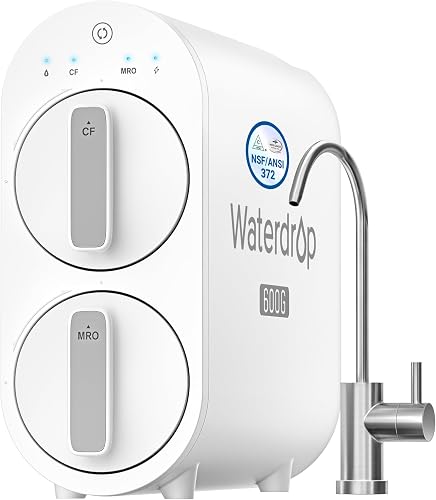
Waterdrop G3P600: best tankless reverse osmosis system for everyday use
Waterdrop G3P600: Best for everyday family use
- 600 GPD capacity
- 2:1 pure-to-drain ratio
- Smart display faucet
- NSF/ANSI 58 and 372 certified
A practical choice for drinking and cooking when you want TDS and filter-life readings at the faucet. Allow room for its tall housing and filter access.
Pros
- Faucet shows TDS and filter life
- Tool-free filter changes
- Automatic flushing
Cons
- Requires under-sink electricity
- Installation calls for faucet and drain connection holes
Choose the G3P600 if you want one faucet for drinking water, cooking water and bottle filling, with maintenance information close at hand. Its 600 GPD rating and 2:1 pure-to-drain ratio form a practical middle ground in this group.
The smart faucet shows TDS and remaining filter life, so you can notice changes without opening the cabinet. Waterdrop says an 8 oz cup takes 8 seconds to fill.
Waterdrop identifies NSF/ANSI 58 certification for TDS reduction, 372 for lead-free materials, and 42 for chlorine, taste and odor reduction. Those named uses give you more useful buying information than the number of filtration stages alone.
Tool-free filter changes and automatic flushing support routine care. Keep the cartridge access clear so those features remain convenient after the cabinet fills with cleaning supplies.
Skip it if a tall housing crowds your plumbing or mineral addition is a must. Our Waterdrop G3P600 review gives this model a closer look.
Waterdrop G2: Best for occasional bottle filling
- 400 GPD capacity
- 1:1 pure-to-drain ratio
- Mechanical faucet
- NSF/ANSI 372 certified
Fits buyers who mainly fill glasses and bottles and prefer a mechanical faucet. Its lower output and less favorable drain ratio make it a weaker fit for frequent pitcher filling.
Pros
- Mechanical faucet without a display
- Shorter housing than the G3 models
- Twist-and-pull filters
Cons
- Lowest rated output in this group
- Most drain water per gallon of filtered water here
Choose the G2 if you mainly fill glasses and personal bottles and prefer a mechanical faucet without a screen. Its 400 GPD rating is the lowest here, and Waterdrop gives a cup-fill time of about 12 seconds.
The tradeoff is water use: its 1:1 ratio sends roughly as much water to the drain as it delivers at the faucet under rated conditions. That matters more for frequent cooking and pitcher filling than for occasional drinks.
Waterdrop names NSF/ANSI 372 certification for lead-free materials. If a specific contaminant drives your purchase, verify the relevant reduction credentials before choosing this model.
Twist-and-pull cartridges simplify access, but they still need clearance in front of the housing. The mechanical faucet also does not remove the system's need for electricity.
Skip the G2 if several people fill large containers in a rush or you want filter reminders at the faucet. It is the simpler faucet choice, rather than the strongest option for heavy daily draws.
Waterdrop G2P600: Best for low-clearance cabinets
- 600 GPD capacity
- 2:1 pure-to-drain ratio
- Filter life indicators
- NSF/ANSI 372 certified
A shorter alternative to the G3P600 for households that want the same rated output and drain ratio. Filter-life indicators help keep cartridge changes on schedule.
Pros
- Short housing with family-oriented output
- Tool-free filter changes
- Filter-life reminders
Cons
- Requires under-sink electricity
- NSF/ANSI 372 addresses materials, not contaminant reduction
Choose the G2P600 when the G3P600 is too tall for your cabinet but you want the same 600 GPD rating and 2:1 drain ratio. Its 14 in housing height makes it worth measuring against low shelves and sink plumbing.
Filter-life indicators provide reminders, and twist-and-pull cartridges let you change filters without moving the housing. That combination suits a busy kitchen where a hard-to-reach filter could otherwise become a neglected chore.
Waterdrop names NSF/ANSI 372 certification for lead-free materials. Buyers choosing RO for a known contaminant should put the required reduction certification ahead of this model's height advantage.
Skip it if faucet-based TDS information is central to your choice. Also avoid forcing it into a narrow gap that leaves no way to reach tubing or remove a cartridge.
If your cabinet can fit the taller G3 housing, our Waterdrop G3P600 vs G3P800 comparison explains whether faucet feedback or a different drain ratio better serves your routine.
Waterdrop G5P700A: Best for mineral-water drinkers

- 700 GPD capacity
- Alkaline mineralization
- 2:1 pure-to-drain ratio
- NSF/ANSI 58 and 372 certified
Choose this compact model if you prefer minerals added after RO filtration. Waterdrop XT provides an accessory route for connecting other water-using appliances.
Pros
- Adds minerals after RO filtration
- Shortest housing in this group
- Smart faucet included
Cons
- Faucet installation requires countertop drilling
- Appliance connections require planning around Waterdrop XT
Choose the G5P700A if you prefer minerals added after RO filtration and want a shorter housing. Waterdrop says its mineralization adds calcium, magnesium, sodium and potassium.
Its 700 GPD rating sits between the G3P600 and the highest-output models here. The compact housing makes it a useful candidate when you want mineral addition without choosing the larger X8-WAN.
Waterdrop identifies NSF/ANSI 58 and 372 certifications. A smart faucet is included, and its 11.3 in height deserves a separate measurement if a shelf or window ledge sits above the sink.
For refrigerator or ice-maker use, Waterdrop offers a connection route through Waterdrop XT. Plan that accessory and the tubing path before treating the system as a shared supply for several appliances.
Skip it if you prefer RO water without added minerals. Mineralization can change the taste, but it should not drive the choice ahead of cabinet fit or treatment suited to your source water.
Waterdrop G3P800: Best for reducing drain water

- 800 GPD capacity
- 3:1 pure-to-drain ratio
- Smart faucet with TDS display
- NSF/ANSI 42, 53, 58 and 372 certified
The strongest fit here for households that draw plenty of filtered water and prioritize a favorable drain ratio. Its housing needs the same cabinet clearance as the G3P600.
Pros
- Lowest rated drain water use in this group
- High rated output
- Front-pull filters
Cons
- Requires under-sink electricity
- Taller housing than the G2 and G5 models
Choose the G3P800 if you use plenty of filtered water and want the most favorable drain ratio in this group. Its 800 GPD rating and 3:1 pure-to-drain ratio make it the clearest fit for that priority.
The ratio matters across repeated pitcher, bottle and cooking-pot fills. Higher rated output also makes this model worth considering when several people need water during the same short part of the day.
Waterdrop identifies IAPMO R&T certification against NSF/ANSI 58 for TDS reduction, alongside 42, 53 and 372 certifications. Match any particular contaminant concern to the exact certified reduction claim.
Its smart faucet shows TDS, and front-pull cartridges allow changes without moving the housing. Leave the front clear rather than placing a bin directly against the filters.
Skip it if your water use is light or the tall housing does not fit comfortably. Our Waterdrop G3P800 review explains its features and cabinet requirements in more detail.
Waterdrop X8-WAN: Best for busy mineral-water households

- 800 GPD capacity
- Alkaline mineralization
- 2:1 pure-to-drain ratio
- Smart faucet shows TDS and filter life
Pairs mineral addition with high rated output and faucet-based filter reminders. Choose it when those features matter enough to allow for the widest housing in this group.
Pros
- Adds minerals after RO filtration
- Faucet shows TDS and filter life
- High rated output
Cons
- Requires countertop drilling for the faucet
- Widest housing in this group
Choose the X8-WAN if your household wants mineral addition, high rated output and filter reminders at the faucet. It combines an 800 GPD rating with a smart digital faucet showing TDS and filter life.
That makes it a specific alternative to the G3P800: prioritize mineral addition here, or prioritize the more favorable drain ratio on the G3P800. The X8-WAN uses a 2:1 ratio.
Waterdrop names NSF/ANSI 42, 58 and 372 certifications and a 24-month RO filter lifespan. That lifespan applies to the RO filter, so do not assume every cartridge shares the same replacement schedule.
The housing is the widest in this group. Check the space beside the disposal and drain trap, including the path needed to bring the unit through the cabinet door.
Skip it if you do not want mineral addition or cannot spare the width. The G5P700A is the smaller mineralizing alternative when fitting the cabinet matters more than the highest rated output.
How much output and drain water should you plan for?
Choose output around your busiest filling session, and compare drain ratios using equal amounts of filtered water. Daily capacity alone does not describe how the faucet will feel during a morning rush.
| Product | Best for | Capacity | Pure-to-drain ratio | Dimensions | Our score |
|---|---|---|---|---|---|
| Waterdrop G3P600 | everyday family use | 600 GPD | 2:1 | 18.12 x 5.67 x 17.72 in | 8.5 |
| Waterdrop G2 | occasional bottle filling | 400 GPD | 1:1 | 17.3 x 5.9 x 14 in | 7.9 |
| Waterdrop G2P600 | low-clearance cabinets | 600 GPD | 2:1 | 17.3 x 5.9 x 14 in | 7.8 |
| Waterdrop G5P700A | mineral-water drinkers | 700 GPD | 2:1 | 16.69 x 5.69 x 13.9 in | 7.7 |
| Waterdrop G3P800 | reducing drain water | 800 GPD | 3:1 | 18.12 x 5.67 x 17.72 in | 7.2 |
| Waterdrop X8-WAN | busy mineral-water households | 800 GPD | 2:1 | 18.2 x 6.25 x 16.72 in | 6.9 |
Read GPD as a production rating
GPD means gallons per day under rated conditions, not gallons stored and ready to pour. A tankless system produces water as you draw it, so faucet flow matters more than the daily total for most kitchens.
Picture your largest regular task: a single bottle, several lunch bottles or a large pot. A modest wait for one glass becomes more noticeable when you repeat it across several containers.
Feed water temperature, pressure and condition can affect membrane output. Use the stated capacity to compare models, then allow for the conditions in your home.
Do not compare cup-fill claims without checking the cup size. A time for a 6 oz cup and a time for an 8 oz cup describe different amounts of water.
Compare drain ratios on equal terms
At 1:1, producing 3 gallons of filtered water sends about 3 gallons to the drain. At 2:1, the same filtered amount sends about 1.5 gallons to the drain; at 3:1, about 1 gallon.
Those examples explain the ratio, rather than predict your total water use. Flushing and changing operating conditions can add to consumption.
Prioritize a favorable ratio if you regularly fill pitchers or cook with RO water. For light use, a system that fits properly and meets your water needs can matter more than the ratio alone.
How do you match filtration to your source water?
Choose filtration around what is in your incoming water, then check the certification for the reduction you need. A stage count, membrane size or TDS display cannot replace that match.
For municipal water, start with your utility's water quality report. Private well water needs current lab results because its condition can vary by location and over time.
RO is not a complete answer to every source-water problem. Sediment, hardness or other conditions may require treatment before the water reaches the RO system.
Understand what the standards cover
NSF/ANSI 372 concerns lead-free materials; it does not certify that a system removes lead from water. NSF/ANSI 58 covers RO systems, with specific reduction claims that you should check individually.
Standards 42 and 53 also involve specific claims. A standard number by itself is not a promise that the system reduces every substance covered by that standard.
For a known concern such as fluoride or a particular PFAS compound, confirm the exact model's certified reduction scope. A broad contaminant list is less useful than a clear match to your water problem.
Decide whether you want minerals added back
Mineralization is a taste and water-style choice. The G5P700A and X8-WAN add minerals after the RO process, while the other picks here do not include that feature.
Added minerals can raise the final TDS reading. That increase does not automatically mean the membrane has stopped working, because the water has changed after passing through it.
A TDS display follows dissolved substances as a group and does not identify them. Use it to notice trends alongside scheduled care, rather than as an all-purpose safety signal.
What must fit before you order a tankless RO system?
Confirm cabinet space, power, faucet placement and service access before buying. All 6 systems need electricity, a feed connection and a drain connection, even though they avoid a separate storage tank.
Measure the usable cabinet space
Measure around the drain trap, disposal, hinges and any fixed shelves. The empty width of the cabinet is not the same as the space where the housing can sit.
Check the route through the door as well as the final position. A unit may fit inside the cabinet yet be awkward to place through a narrow opening.
Leave room to pull cartridges out and reach connections. A housing pressed tightly against plumbing can turn a quick filter change into a larger job.
Plan the faucet and electrical connection
Check the space above and below the proposed faucet hole. The mounting hardware needs access beneath the sink deck, while the spout needs room to turn and dispense into your usual containers.
The G3P600 instructions call for a faucet opening and a separate drain connection hole. Other models also have drilling requirements, so use the exact model's template and instructions.
Arrange a suitable outlet without placing connections where a leak could wet them. Follow local electrical requirements and get qualified help if the cabinet needs a new outlet.
If you cannot add a faucet opening or power connection, reconsider the layout before ordering. Our best under-sink reverse osmosis systems guide covers a wider range of choices.
What should you do during installation and the first fill?
Follow the model's instructions for connections, flushing and the first usable water. Treat setup as a careful plumbing job, even when Waterdrop describes a short installation time.
Check the feed pressure and source-water limits before connecting anything. A pump inside a tankless system does not make every feed-water condition suitable.
Shut off the supply, release pressure and protect the cabinet floor before work begins. Route tubing without sharp bends, tension or contact with moving storage drawers.
Follow the drain connection instructions closely, including its position. Keep the wastewater line connected as intended rather than improvising a collection setup under the sink.
Complete the required startup flush before using the water. The exact flush procedure matters more than a general rule about how many glasses to discard.
Check dry connections for moisture while water flows and again afterward. Leave the cabinet easy to inspect during early use so a small seep does not stay hidden behind stored items.
For the overall sequence and the parts involved, read our reverse osmosis installation guide. Bring in a plumber if drilling, drain placement or access makes the job uncertain.
How do you keep a tankless RO system working well?
Keep filters on the model's replacement schedule, maintain clear access and respond to changes in flow or taste. Tankless systems remove the storage tank, but they still need cartridge care and clean water-contact parts.
Plan cartridge care before buying
Identify the exact replacement cartridges for the model you choose. Similar system names do not guarantee that their filters are interchangeable.
Compare the full set of required cartridges, their schedules and how easily you can get replacements. A long membrane interval does not eliminate more frequent care for other filters.
Record the installation date and each cartridge change. Reset the correct filter indicator after replacement so the reminder follows the new cartridge.
Our guide to how long reverse osmosis filters last explains why water use and incoming water condition affect replacement needs.
Respond to changes rather than ignoring them
If flow drops, check the supply valve, tubing and filter reminders before assuming the membrane has failed. Follow the model's troubleshooting steps instead of repeatedly resetting an alert.
A sudden taste change, persistent odor or unexplained TDS shift deserves attention. If the source water may be unsafe, use another suitable drinking-water supply while you resolve the cause.
Clean the faucet outlet and keep the cabinet dry and easy to inspect. After a long period away, follow the system's instructions for restarting and flushing.
Which buying mistakes are easiest to avoid?
Avoid choosing by the largest capacity number or the smallest housing alone. A good fit includes water needs, access for care and the work required to install it.
- Buying before measuring: Include plumbing, cartridge removal and the cabinet doorway.
- Confusing materials certification with removal: Lead-free materials do not prove lead reduction.
- Treating a mechanical faucet as power-free: The G2 still needs electricity.
- Ignoring replacement cartridges: Check the correct filter family and every required change interval.
- Adding a refrigerator connection without planning: Confirm accessory requirements and appliance pressure needs.
- Choosing minerals for a health promise: Pick mineralization because you prefer that water style.
A refrigerator deserves special attention because its valve and tubing add demands beyond the RO faucet. A simple connection may not deliver the pressure or flow the appliance expects.
Waterdrop recommends a PMT pressure tank for G2 refrigerator connections and Waterdrop XT for G5P700A appliance connections. Check the exact arrangement before planning one system around several outlets.
For a step-by-step way to weigh these tradeoffs, use our guide to choosing a reverse osmosis system for your kitchen.
Which tankless reverse osmosis system should you choose?
Choose the best tankless reverse osmosis system by solving your main constraint first: water treatment needs, cabinet fit, filling routine or preference for added minerals. Then check installation access and replacement cartridges before committing.
Pick the G3P600 for everyday drinking and cooking with clear faucet feedback. Choose the G2P600 when a shorter housing makes the difference, or the G2 for lighter use with a mechanical faucet.
Pick the G3P800 when reducing drain water is your main priority. Choose the G5P700A for mineral addition in a compact housing, or the X8-WAN for mineral addition with higher rated output and faucet-based filter reminders.
Once you have a clear fit, stop comparing features you will rarely use. For more options within the brand, see our guide to Waterdrop reverse osmosis systems.
Our top 3 picks at a glance
-
1
-
2
-
3
Frequently asked questions
What is the best tankless reverse osmosis system for most kitchens?
The Waterdrop G3P600 is the best fit for most kitchens because it combines useful faucet feedback with output suited to everyday drinking and cooking. Choose a shorter model if cabinet clearance is tight, or a mineralizing model if you prefer that water style.
Confirm fit and power access before ordering.
Do tankless reverse osmosis systems need electricity?
All 6 systems here require electricity, including the G2 with its mechanical faucet. Arrange a suitable outlet and follow the model's electrical instructions before installation.
A mechanical faucet does not make the filter system power-free, and you should not plan on normal dispensing during an outage without model-specific guidance.
What does a pure-to-drain ratio mean?
A pure-to-drain ratio compares filtered water with wastewater. At 2:1, producing 2 gallons of filtered water sends about 1 gallon to the drain under the rated conditions.
Compare ratios using the same amount of filtered water, and remember that flushing and operating conditions can affect total water use.
Should you choose an RO system with mineralization?
Choose mineralization if you prefer water with minerals added after RO filtration. The G5P700A and X8-WAN offer this feature, which can change taste and raise the final TDS reading.
It is a water preference, not a reason to assume greater contaminant reduction or a health benefit.
Can a tankless RO system supply a refrigerator?
Some setups can supply a refrigerator, but check the system's connection instructions and the appliance's pressure needs first. Waterdrop recommends a PMT pressure tank for G2 refrigerator connections and Waterdrop XT for G5P700A appliance connections.
Do not assume a simple tubing tee will provide the required flow and pressure.
Does a low TDS reading prove that RO water is safe?
No. TDS measures dissolved substances as a group, so it cannot identify every contaminant or detect every water safety problem.
Use the display to follow changes alongside proper maintenance. Choose treatment based on your source water and the system's specific reduction certifications, rather than a low number alone.