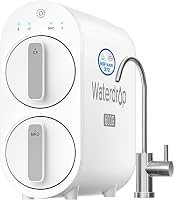
Waterdrop G3P800 Review: Worth It? (October 2026)
The Waterdrop G3P800 suits busy households that want fast tankless RO dispensing with less drain water. Choose the G3P600 for routine drinking-water use, the X8-WAN for added minerals or the KJ600 for hot drinks.
On this page (9 sections)
- The Waterdrop G3P800 at a glance
- What do the capacity and drain ratio mean in daily use?
- What filtration does the G3P800 provide?
- Will the G3P800 fit under your sink?
- How useful is the smart faucet?
- What care does the G3P800 need?
- Which Waterdrop alternative fits your routine?
- Which mistakes should you avoid before ordering?
- Should you choose the Waterdrop G3P800?
The Waterdrop G3P800 is a good fit for busy households that want fast tankless RO dispensing and less drain water. Choose it for repeated bottle fills and cooking prep, provided your cabinet, electrical supply and source water meet its requirements.
The strongest reason to step up from the G3P600 is water-use efficiency. Added minerals and hot-water dispensing are separate needs, better served by the X8-WAN and KJ600.
The Waterdrop G3P800 at a glance
The G3P800 combines 800 GPD rated capacity with a 3:1 pure-to-drain ratio. It makes sense when several people use the filtered-water faucet throughout the day and you want to limit the water sent down the drain.
Waterdrop G3P800: Best for busy family kitchens

- 800 GPD rated capacity
- 3:1 pure-to-drain ratio
- Smart faucet with TDS display
- NSF/ANSI 42, 53, 58 and 372 certifications
A tankless RO system for families filling bottles, drinking glasses and cooking pots throughout the day. Its drain-water efficiency is the main reason to choose it over the G3P600.
Pros
- Higher rated capacity than the G3P600
- Smart faucet displays TDS
- Front-pull filters allow replacement without moving the system
- More filtered water per cup of drain water than the alternatives here
Cons
- Requires an electrical outlet
- Needs clear space in front for filter access
- Filter replacement intervals need confirmation for each cartridge
Its tankless layout removes the need for a separate RO storage tank. That leaves more flexibility around pipes and cleaning supplies, although the unit still needs room for tubing and service access.
The box includes the system, 3 pre-installed filters, a smart faucet and a user manual. Plan the full installation before ordering, including where the faucet will sit and how you'll reach the filters later.
Who should buy the Waterdrop G3P800?
Buy it if frequent filling and drain-water efficiency matter more than added minerals or hot drinks. A household filling school bottles, a coffee kettle and cooking pots has a clearer reason to choose it than someone drawing a few glasses daily.
Skip it if you can't provide electrical access or make the required plumbing connections. Renters should settle permission for any faucet or drain changes before buying.
Also skip it if you specifically want mineralized water or adjustable hot water. Choosing those features from the start is simpler than planning an unconfirmed accessory setup.
What do the capacity and drain ratio mean in daily use?
The daily capacity describes production under rated conditions, while the drain ratio describes filtered water relative to wastewater. Neither figure means your household needs to drink hundreds of gallons to benefit from the system.
Waterdrop says the G3P800 fills a cup in 5 seconds. Since no cup size accompanies that claim, use it as a broad speed guide rather than a precise bottle-filling estimate.
Actual RO production depends on conditions such as incoming water temperature, pressure and filter condition. Think about your busiest period, such as several people filling bottles before leaving home, rather than daily drinking volume alone.
Compare drain water for the same amount of drinking water
At a 3:1 ratio, producing 3 gallons of filtered water sends 1 gallon to the drain. At a 2:1 ratio, producing that same amount sends 1.5 gallons to the drain.
That difference matters more in a kitchen using RO water for both drinking and cooking. These examples explain the ratios; automatic flushing and operating conditions can affect total water use.
A higher capacity doesn't automatically mean a smaller cabinet footprint. Compare the space and operating differences in our tankless vs tank reverse osmosis guide, or use how to choose a reverse osmosis system to narrow the system type first.
What filtration does the G3P800 provide?
Waterdrop identifies 10-stage filtration and certification by IAPMO R&T against NSF/ANSI 42, 53, 58 and 372. Match the specific reduction claims to your source water instead of choosing by stage count alone.
Waterdrop specifies NSF/ANSI 58 certification for TDS reduction and describes 42 and 53 coverage for chlorine, taste, odor and other reductions. NSF/ANSI 372 concerns lead-free materials, so it should not be read as proof of lead removal from water.
Waterdrop also reports reductions of PFAS, fluoride, lead, chromium, nitrate and other substances. Ask for the performance documentation covering your particular concern, including any applicable source-water limits.
The G3P800 supports incoming water with a maximum TDS of 500 ppm. Check that limit before ordering, especially if your water is mineral-heavy or comes from a private well.
Start with your utility's water report or a current private-well water analysis. Source-water problems may require treatment before the RO system, so don't assume an under-sink unit can handle every well-water condition by itself.
For the lower-capacity alternative, our Waterdrop G3P600 review explains where that model fits.
Will the G3P800 fit under your sink?
The G3P800 needs space for the cabinet unit, connections and front filter access, plus a suitable electrical outlet. Measuring only the empty cabinet width can miss the obstacles that make installation difficult.
The unit measures 18.12 inches long, 5.67 inches wide and 17.72 inches high. Make a cardboard footprint and check it against the disposal, drain trap, shutoff valves and cabinet door opening.
Allow room above and behind the unit for the connections required by the manual. Keep the front clear enough to pull filters out without unloading the whole cabinet.
Before buying, check these installation details:
- Faucet position: Confirm the required hole size and room for fastening the faucet beneath the sink or counter.
- Water connection: Locate the cold-water shutoff and check the connection requirements.
- Drain route: Plan the drain connection exactly as directed, with tubing protected from kinks.
- Electrical access: Keep the outlet and plug accessible, with cords clear of likely leaks.
- Service space: Make sure the system can be reached without moving fixed plumbing.
Don't assume a spare sink opening is the correct size. If the counter needs drilling, confirm the material and arrange suitable help before installation day.
Our reverse osmosis installation guide explains the general work involved. Use Waterdrop's manual for the exact parts, clearances and startup sequence.
How useful is the smart faucet?
The G3P800's smart faucet shows TDS and lights its LED when water flows. The display is useful for tracking dissolved-solids trends, but it doesn't identify individual contaminants.
TDS means total dissolved solids, which can include minerals and salts. A low reading doesn't prove the absence of every unwanted substance, and a higher reading doesn't tell you which substance caused it.
Learn the usual reading after the system has completed its required startup flush. If it changes unexpectedly, check filter status, source-water changes and the troubleshooting instructions rather than replacing parts at random.
Keep display readings in context when comparing different systems. Added minerals can affect TDS, so the X8-WAN's reading shouldn't be judged by the same expectation as RO water without mineralization.
What care does the G3P800 need?
The G3P800 uses front-pull filters that can be changed without moving the unit. Keep that access clear and maintain a separate replacement record for each cartridge.
Confirm the correct filter identifiers, replacement intervals and availability before buying the system. Different filters perform different jobs, so don't assign one replacement date to the entire set unless the manual directs it.
For routine care:
- Record the installation date and each filter change.
- Follow the required flushing steps after startup and replacements.
- Check visible tubing and connections for moisture.
- Keep stored bottles and cleaning supplies from pressing against tubing.
- Follow the manual's restart instructions after a long period without use.
A good TDS reading isn't a reason to postpone every filter change. Some cartridges address taste, odor or sediment, and the display doesn't measure each of those functions separately.
For a broader maintenance plan, read how long reverse osmosis filters last. Use that guide to understand the tasks, then follow the model-specific schedule.
Which Waterdrop alternative fits your routine?
Choose the G3P600 for routine drinking water, X8-WAN for added minerals or KJ600 for hot drinks. The G3P800 remains the choice here for buyers putting more weight on drain-water efficiency.
| System | Main reason to choose it | Main reason to skip it |
|---|---|---|
| Waterdrop G3P800 | Frequent filling with a more efficient drain ratio | You need mineralization or hot-water dispensing |
| Waterdrop X8-WAN | RO filtration with added minerals | Added minerals aren't part of your goal |
| Waterdrop KJ600 | Adjustable hot water for drinks and food prep | You need a refrigerator or ice-maker connection |
| Waterdrop G3P600 | Everyday use with a filter-life display | Drain-water efficiency is your deciding factor |
For the closest comparison, see Waterdrop G3P600 vs G3P800. Browse our Waterdrop reverse osmosis guide if your requirements extend beyond these options.
G3P600: for everyday bottles, glasses and kettle fills
The G3P600 offers 600 GPD rated capacity and a 2:1 pure-to-drain ratio. It's the practical alternative when routine drinking-water use matters more than the G3P800's higher output.
Its smart faucet shows TDS and filter life, and its cabinet dimensions match the G3P800. Choosing it doesn't reduce the space you need beneath the sink.
Skip it if minimizing drain water is your main goal. It also doesn't solve a kitchen's lack of electrical access.
X8-WAN: for people who prefer added minerals
The X8-WAN combines 800 GPD rated capacity with alkaline mineralization. Choose it because you want minerals added after RO filtration, rather than assuming that alkaline water is necessary for every household.
Its faucet displays TDS and filter life, and its drain ratio is 2:1. The stated 24-month lifespan applies to the RO filter, so check the schedule for the other cartridges separately.
Waterdrop specifies countertop drilling for the faucet. Skip this model if that work isn't acceptable or you prefer RO water without added minerals.
KJ600: for frequent hot drinks and quick food prep
The KJ600 adds adjustable hot-water settings from 104°F to 203°F. It's useful for tea, instant coffee and oatmeal when you want filtration and heating at one faucet.
Heating from room temperature to the highest setting can take about 15 minutes. Set the temperature ahead of use, and allow recovery time after repeated draws.
The faucet includes a child lock and temperature indication, but you still need care around hot water. Waterdrop recommends a separate socket for this model.
Skip it if you need a refrigerator or ice-maker connection, since the KJ600 cannot serve those appliances. Its compatible MNR remineralization filter can connect only to the cold-water pipe.
Which mistakes should you avoid before ordering?
The biggest mistakes are buying by capacity alone and leaving installation planning until delivery. A model with suitable filtration still needs to fit your water supply and kitchen.
Don't rank systems by filtration-stage count. More stages don't establish stronger reduction of the particular substance you want to address.
Don't confuse a tankless layout with an installation that needs no cabinet planning. Pipes, power, faucet access and future filter changes all need space.
Don't treat a faucet's TDS display as a complete water-quality check. Use the right analysis for a specific contaminant concern.
Finally, include replacement filters and installation work in your budget. Our reverse osmosis system cost guide helps organize those ongoing and upfront expenses.
Should you choose the Waterdrop G3P800?
Choose the Waterdrop G3P800 when frequent filling and lower drain-water use are worth prioritizing. Before ordering, settle the cabinet fit, electrical access, source-water limit and cartridge replacement plan.
Choose the G3P600 for everyday drinking-water use, the X8-WAN for mineralization or the KJ600 for adjustable hot water. Those needs give you a clearer decision than capacity or site score alone.
If none fits your installation, compare our best tankless reverse osmosis systems using your cabinet measurements and water report.
Frequently asked questions
Is the Waterdrop G3P800 worth considering?
Yes, the G3P800 is worth considering for a busy kitchen where dispensing speed and drain-water efficiency matter. Its rated capacity is 800 GPD, with a 3:1 pure-to-drain ratio.
Choose it after confirming cabinet clearance, electrical access, source-water suitability and the replacement schedule for each filter.
What is the difference between the Waterdrop G3P800 and G3P600?
The G3P800 offers higher rated capacity and better drain-water efficiency: 800 GPD and a 3:1 ratio, compared with 600 GPD and 2:1 for the G3P600. Both have the same cabinet dimensions.
The G3P600 includes a filter-life display, so choose around water use and maintenance preferences.
Does the Waterdrop G3P800 need electricity?
Yes, the G3P800 needs electricity because it is a corded electric system. Plan for a suitable outlet near the installation location, plus access to the cold-water supply and drain.
Check the manual before arranging electrical work, and keep the plug accessible after placing the system.
How often do Waterdrop G3P800 filters need replacement?
Follow the current Waterdrop manual for each G3P800 cartridge rather than assigning one interval to all 3 filters. Record installation and replacement dates, keep the correct filter identifiers, and complete any required flushing after a change.
A low TDS reading does not replace scheduled filter care.