Under Sink vs Countertop Reverse Osmosis: Which Is Better? (October 2026)
For under sink vs countertop reverse osmosis, choose under sink for a fixed faucet without manual feed-tank refills. Choose countertop if avoiding plumbing changes matters more than keeping the counter clear.
On this page (11 sections)
- Under sink vs countertop reverse osmosis: what changes in daily use?
- Which format fits your kitchen space?
- Which system is easier to set up?
- Who should buy the APEC ROES-50?
- Who should buy the Waterdrop C2SL?
- Who should buy the Waterdrop M6SL?
- Does either format filter water better?
- How much water will you refill, store and discard?
- What care will each setup need?
- Which buying mistakes should you avoid?
- Which under sink or countertop reverse osmosis system should you choose?
For under sink vs countertop reverse osmosis, choose under sink if you want a permanent drinking-water faucet without manual feed-tank refills. Choose countertop if avoiding plumbing changes matters more than keeping your worktop clear.
The APEC ROES-50 suits a kitchen where filtered water is part of cooking and daily bottle filling. The Waterdrop C2SL and M6SL suit people who prefer a refillable appliance they can relocate.
The deciding factor is the work you'll accept: installation beneath the sink, or ongoing tank handling above it. Start there before comparing controls or filtration stages.


Under sink vs countertop reverse osmosis: what changes in daily use?
The water supply and dispensing routine change most. A plumbed system draws from the cold-water supply, while these countertop models depend on water you add to their feed tanks.
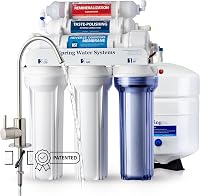
With the APEC, you collect water at a dedicated sink faucet. Its storage tank holds filtered water between uses, so the cabinet becomes part of your drinking-water setup.
With the Waterdrop units, you carry tap water to the appliance and collect filtered water in a detachable pitcher. That pitcher can go to the table or refrigerator, which helps if you prefer chilled drinking water.
Neither arrangement filters every faucet in your home. Think about the glasses, bottles and cooking water you want to supply, rather than your household's total water use.
A fixed system removes a recurring chore, while a countertop system avoids a plumbing project. The better choice depends on which benefit you'll use every day.
Which format fits your kitchen space?
Choose by usable space, including access for care. An appliance that fits on paper can still block food preparation or make filter changes awkward.
For under-sink RO, measure around the drain trap, disposal, supply valves and anything else inside the cabinet. Allow room for the filter assembly and tank, plus access to remove filters and reach shutoff valves.
Don't plan to pack supplies tightly around tubing. You need to see connections and reach them without unloading the entire cabinet.
The C2SL measures 15.8 x 6.1 x 11.4 inches, while the M6SL measures 15.9 x 9.3 x 14.5 inches, in length x width x height. The C2SL is the easier fit on a narrow counter.
Leave extra clearance to handle the feed tank and remove the pitcher. Check that upper cabinets won't block those movements, and choose a position with a suitable outlet away from routine splashes.
Under-sink or countertop RO for a small kitchen?
Protect the space you use most. Under-sink RO often makes sense when prep space is scarce, provided the cabinet can hold the equipment and remain accessible.
Countertop RO can work better when the cabinet is already crowded or difficult to reach. Mark the appliance footprint with paper before ordering, then try preparing a meal around it.
Which system is easier to set up?
The countertop models require less installation work, but they still need startup rinsing and correct assembly. Neither Waterdrop model needs drilling, a faucet connection or sink-plumbing changes.
Place the appliance on a stable surface, follow its setup sequence and complete the required flush before collecting drinking water. Don't skip flushing to save time, including after filter replacement when the instructions require it.
The C2SL provides voice-guided first-time rinsing and filter setup. For the M6SL, keep the pitcher on the unit during flushing, as Waterdrop instructs.
The APEC requires a cold-water connection, drain connection and dedicated faucet. Its quick connection fittings, colored tubing and included installation kit help organize the job, but you still need to make secure connections.
Check for an available faucet opening before committing to under-sink RO. If drilling or unfamiliar plumbing work is involved, our guide to reverse osmosis system installation costs helps you plan for professional help.
Review how to install a reverse osmosis system before deciding to do the work yourself. After installation, follow the startup instructions and check connections for leaks before returning stored items to the cabinet.
Which format suits renters or frequent moves?
Countertop RO is the simpler choice when you can't alter the sink. It also avoids disconnecting plumbing each time you move.
For an under-sink installation in a rental, get permission for the connections and any faucet work first. Consider who will restore the sink area when you leave.
Who should buy the APEC ROES-50?
Choose the APEC for frequent kitchen use and a permanent faucet. It's the strongest fit here if several daily tasks would otherwise mean repeated trips to refill a countertop tank.
Its 5-stage system is rated for 50 gallons per day, and it includes a storage tank and brushed nickel faucet. That daily figure describes water production, not the amount stored or the speed of a single pour.
A storage tank can be drawn down during heavy use and then needs time to refill. If you regularly fill large pots and several bottles together, consider how clustered those demands are.
The APEC's operating pressure range is 40–85 psi. Check your incoming pressure before choosing it, especially if the kitchen already has weak flow.
Skip this model if you can't make plumbing changes or need the cabinet for essential storage. It also adds little convenience if you rarely use filtered water and would rather avoid a fixed installation.
The APEC ROES-50 review offers a closer look at this model. For alternatives with different cabinet layouts, see the best under-sink reverse osmosis systems.
Who should buy the Waterdrop C2SL?
Choose the C2SL for 1–2 people who want a narrow countertop system. Its automatic pitcher refill suits a household that pours water throughout the day and keeps the feed tank topped up.
The unit has a 108 oz feed tank and 40 oz glass pitcher. Those are separate capacities: water in the feed tank hasn't all become drinking water, and RO also produces a waste stream.
The automatic refill saves you from starting each pitcher fill manually. It doesn't remove the need to add source water, keep the containers clean or follow the wastewater-handling instructions.
Waterdrop adds calcium, magnesium, potassium and sodium for taste. Choose that feature for your drinking preference rather than as a way to meet dietary needs.
Skip the C2SL if several people will rely on it for frequent large fills. Its compact footprint helps a small kitchen, but a small household's drinking station is a better match than a busy shared cooking supply.
Who should buy the Waterdrop M6SL?
Choose the M6SL if repeatable drink portions matter more than a narrow footprint. Its touch controls offer 5 dispensing volumes and a favorite setting for a pour you use often.
Available portions include 4 oz, 8 oz and 16 oz. That helps with filling a familiar mug or bowl without judging the amount by eye, though recipes may still call for a separate measuring tool.
Its 185 oz combined tank capacity consists of 135 oz for tap water and 50 oz for wastewater. Don't read the combined figure as drinking-water storage or compare it directly with the C2SL's feed capacity.
The M6SL keeps those water sections separate and includes a detachable glass pitcher. Like the C2SL, it adds minerals for taste and supplies room-temperature water; chilling requires the refrigerator.
Skip it if you only want basic pitcher filling and counter space is tight. The extra width is easier to justify when you'll use the portion controls regularly.
Does either format filter water better?
Placement doesn't determine filtration performance. Match the exact system's reduction claims and operating limits to your source water, rather than choosing by countertop or under-sink format alone.
Don't rank these systems by stage count. An extra stage may serve a different purpose, such as adding minerals, rather than showing greater reduction of a contaminant you care about.
Check what each certification covers, too. A lead-free-materials certification addresses materials and doesn't by itself establish removal of every substance from incoming water.
Source-water limits can settle the choice before kitchen layout does. The C2SL supports incoming TDS up to 500 ppm, compared with 300 ppm for the M6SL.
TDS means total dissolved solids, and the reading doesn't identify which substances are present. Use a water-quality report or appropriate water analysis to understand a specific concern.
Don't assume one of these systems can make any untreated source safe. Confirm source-water suitability before buying, especially for a private well or a supply with known problems.
How much water will you refill, store and discard?
Plan around busy periods, rather than daily production figures alone. Breakfast, packed lunches and dinner can create several water demands close together.
List the bottles, kettle fills and cooking pots you use during one busy period. That gives you a more useful picture than counting household members alone.
For countertop RO, feed-water capacity, filtered-water storage and waste capacity mean different things. A larger source tank reduces some refill trips, but it doesn't make an entire tank immediately available to pour.
Both Waterdrop models have a 3:1 pure-to-drain ratio, meaning 3 parts filtered water for 1 part wastewater. Treat wastewater handling as a normal chore, and don't return that water to the feed tank.
For the APEC, think about stored supply and recovery after a large draw. If you want to compare how under-sink designs handle storage, read tankless vs tank reverse osmosis.
What care will each setup need?
Both formats need filter replacement, cleaning and attention to water flow. Countertop RO avoids plumbing work, but its removable containers add regular washing and handling.
APEC recommends ROES-50 filter changes every 6–24 months, depending on incoming water quality. Follow the schedule for each filter component rather than assuming the longest interval applies to every part.
The C2SL filter lasts up to 528 gallons or 12 months, with actual life depending on water quality and use. The M6SL has a 12-month filter interval.
The C2SL has display information and voice alerts, while the M6SL has a filter-life indicator and alerts. Use those reminders alongside the instructions, and keep a record of replacement dates.
Wash removable containers as directed, including lids and pouring areas. Empty wastewater when required, and follow the shutdown and restart guidance before and after a long period away.
For under-sink equipment, keep connections visible and look for dampness during routine cabinet use. Avoid pulling tubing when taking out cleaning supplies or changing filters.
Our guide to how long reverse osmosis filters last explains why replacement timing varies. Include replacement parts, cleaning and any installation help in your ownership budget.
Which buying mistakes should you avoid?
Avoid comparing numbers that describe different jobs. Daily production, feed-tank volume and finished-water storage aren't interchangeable measures of convenience.
Before ordering, check these common trouble spots:
- Measuring only the appliance: leave room for filter changes, tank handling and pitcher removal.
- Expecting instant bulk output: plan for refill or recovery time after several large draws.
- Treating automatic filling as automatic supply: the C2SL still needs you to refill its feed tank.
- Choosing by stage count alone: start with source-water suitability and relevant reduction claims.
- Assuming minerals prove better filtration: remineralization changes the finished water's mineral content and taste.
- Forgetting access after setup: a cramped cabinet or blocked countertop tank makes care harder to keep up with.
Also decide where the filtered water will go. If you prefer chilled water, reserve refrigerator space for the pitcher instead of discovering later that it competes with everyday food storage.
Which under sink or countertop reverse osmosis system should you choose?
Resolve under sink vs countertop reverse osmosis by choosing the routine you'll maintain. Check water compatibility first, then installation permission and space, and finally how often you'll collect water.
Pick the APEC ROES-50 for a permanent kitchen where frequent bottle and pot filling makes manual feed-tank refills inconvenient. Allow room for the tank and service access before arranging installation.
Pick the Waterdrop C2SL for a small household that wants automatic pitcher refills without altering the sink. Pick the Waterdrop M6SL when measured portions justify a wider countertop appliance and separate wastewater handling.
Before ordering, use our guide to choosing a reverse osmosis system to check your water supply and installation needs. Then measure the full working space, including where your hands need to reach.
Sources
Frequently asked questions
Is under sink or countertop reverse osmosis better?
Under-sink RO is better for a permanent kitchen where you want water at a dedicated faucet without manual feed-tank refills. Countertop RO suits renters and smaller households that want to avoid plumbing changes.
Choose by available space, permission to install and how much water you collect throughout the day.
Does countertop reverse osmosis need to be installed?
The Waterdrop C2SL and M6SL need no plumbing installation, but both need initial setup and flushing. Place the unit near a suitable outlet, leave room to handle its tanks and pitcher, and follow the startup instructions.
Keep the M6SL pitcher on the unit throughout flushing.
Does an under-sink RO system need its own faucet?
The APEC ROES-50 uses a separate faucet and includes a brushed nickel faucet and storage tank. Check for a suitable faucet opening and room beneath the sink before ordering.
Our guide to installing a reverse osmosis system explains the connections and helps you judge whether to hire a plumber.
Which reverse osmosis system is easier to move?
The countertop systems are easier to relocate because they have no sink-plumbing connections to disconnect. Empty and prepare the unit according to its instructions before moving, and protect the glass pitcher.
Moving the APEC also means disconnecting the water supply, drain connection, faucet and storage tank.
How do you choose between countertop and under-sink RO?
Start with installation permission and usable space, then compare your daily water routine. Choose a fixed system if frequent bottle and pot filling makes manual refills inconvenient.
Choose countertop if portability matters more, provided your source water meets the model's limits and you can reach its tanks easily.