Is a Reverse Osmosis System Worth It?
A reverse osmosis system is worth it when its contaminant reduction matches your water needs and you'll maintain it. For taste and chlorine concerns alone, a simpler under-sink filter may be enough.
On this page (10 sections)
- Is a reverse osmosis system worth it for your water?
- Who should choose the iSpring RCC7AK-BN?
- When is the Waterdrop TSU a better choice than RO?
- What are the main trade-offs of reverse osmosis?
- How do you choose an RO system that fits your kitchen?
- What should you check before installation?
- How much does reverse osmosis cost over time?
- How do you keep filters working properly?
- Which common mistakes make RO less worthwhile?
- Is a reverse osmosis system worth it for your household?
A reverse osmosis system is worth it when you need specific contaminant reduction, use filtered drinking water regularly and can keep up with maintenance. For chlorine taste alone, a suitable non-RO filter may do the job with less plumbing.
The best choice starts with your water, rather than the number of filter stages. A useful system solves a defined problem without creating more work than you're willing to take on.
For a quick overview of both approaches, see our guide to under-sink water filters and RO systems.
Is a reverse osmosis system worth it for your water?
RO is worth considering when a system's documented reductions match something you want to reduce in your drinking water. Start with a water report, then choose the filtration method.
For municipal water, read your utility's annual water quality report. Because water can also pick up substances from building plumbing, a sample from your kitchen tap may help answer concerns about your own pipes.
For a private well, use a qualified laboratory to assess the water before choosing treatment. A kitchen filter should fit into a plan for the well's actual water quality.
Write down the substances that matter to you. Lead, fluoride, dissolved salts and chlorine taste are different goals, so they do not all call for the same filter.
Check both the system's certification and the specific reduction claim. A certification for material safety is different from evidence that a complete system reduces a particular contaminant.
When is reverse osmosis worth the extra upkeep?
The extra upkeep makes sense when simpler filtration cannot meet your goal or you want one dedicated tap that addresses several documented concerns. It makes less sense when you cannot name a benefit beyond wanting a lower meter reading.
TDS means total dissolved solids, which includes dissolved minerals and salts. It is not a list of harmful substances, so a higher number alone does not prove that your water needs RO.
Taste also has limits as a guide. Water can taste fine while containing an unwanted substance, and mineral-rich water can taste different without that difference identifying a safety problem.
Who should choose the iSpring RCC7AK-BN?
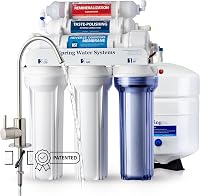
The iSpring RCC7AK-BN suits buyers who want under-sink RO with remineralization and have room for a storage tank. It is a practical option when dissolved-solids reduction is part of the goal.
iSpring identifies the complete system as NSF/ANSI 58 certified. The brand reports reductions of 93–98% for TDS and 96–99% for PFAS, along with reductions for lead, fluoride and other specified substances.
Compare those claims with your water concerns rather than choosing by the length of the contaminant list. No percentage should be read as a promise of identical results with every source-water condition.
The system's rated production is 75 gallons per day, which describes daily production rather than instant faucet flow. Its tank stores treated water for use between refill cycles.
The faucet's top-mounted fastener lets you secure it from above the counter, reducing work in the tight space behind the sink. Quick-fitting connections and color-coordinated tubing also help with setup, and the system operates without electricity.
Skip this model if you cannot spare room for a tank or only want to improve taste. Its mineral stage adds another feature to maintain, and a change in pH is not a reason to expect a health benefit.
When is the Waterdrop TSU a better choice than RO?
The Waterdrop TSU is a better fit for municipal-water taste and odor concerns when you want to retain minerals and avoid a drain connection. It uses ultrafiltration rather than reverse osmosis.
This system does not reduce TDS. Choose it because its filtration claims suit your needs, not because you expect an RO result from a smaller unit.
Waterdrop describes reductions for chlorine, PFAS, taste, odor and heavy metals. Its IAPMO NSF/ANSI 372 certification concerns lead-free construction and should not be read as certification of every contaminant-reduction claim.
The TSU produces no wastewater, needs no drain line and operates without power. Its maximum flow is 1.05 gallons per minute, and its narrow body measures 14.81 inches long, 4.68 inches wide and 13.97 inches high.
Those features suit a crowded cabinet, but you still need space for tubing and filter changes. The separate brushed nickel faucet also calls for countertop drilling, so the smaller filter does not eliminate all installation work.
Skip the TSU for well water, hot water or a dissolved-solids reduction goal. For a closer comparison of the two filtration approaches, read our under-sink water filter vs reverse osmosis guide.
Our best under-sink water filters guide can help if a non-RO system matches your needs.
What are the main trade-offs of reverse osmosis?
RO adds water treatment, plumbing and maintenance in exchange for the reductions your chosen system provides. The practical question is whether those benefits justify the space and care in your kitchen.
| Decision | Reverse osmosis | Non-RO under-sink filtration |
|---|---|---|
| Dissolved solids | Can reduce dissolved solids | Many systems retain dissolved minerals |
| Drain connection | Commonly required | Some systems need no drain |
| Cabinet layout | May include a storage tank | Often has no storage tank |
| Faucet | Commonly uses a dedicated tap | Depends on the system |
| Filter care | Stages may follow different schedules | Schedule depends on filter design |
| Best reason to buy | Documented reductions match your water concerns | Targeted filtration meets your needs |
RO divides incoming water into treated water and a stream that carries rejected substances to the drain. Compare a system's water-use information before buying, especially where water conservation matters.
Tank systems also need time to refill after heavy use. Filling several large cooking pots in a row can create a different demand from pouring a few glasses throughout the day.
Tankless RO removes the storage tank from the layout, but you still need room for the unit and service access. Compare power requirements, output and installation needs in our tankless vs tank reverse osmosis guide.
Neither kitchen format treats all household water. If your concern affects showers, laundry or plumbing, a drinking-water tap addresses only part of the problem.
How do you choose an RO system that fits your kitchen?
Choose by source-water requirements, usable output and service access before comparing extras. A system that fits the cabinet but cannot work well with your incoming water is a poor match.
Start with the manufacturer's allowed water pressure, temperature and source-water conditions. Hardness, sediment and other water conditions can affect whether pretreatment is needed.
Low feed pressure can reduce RO production. Check the system's requirements before adding equipment, and use our guide to whether reverse osmosis needs a booster pump if pressure is a concern.
Next, think about your busiest use period. Count drinking bottles, kettle fills and cooking water, rather than comparing daily capacity numbers alone.
A daily production rating does not mean that amount is available at once. Feed conditions, tank storage and faucet delivery all affect how the system serves your kitchen.
Measure the filter area, tank location and the space needed to remove cartridges or housings. Leave access to shutoff valves, the garbage disposal and drain plumbing.
Finally, check replacement-part compatibility and availability. A clear filter schedule and parts you can identify easily are more useful than an extra stage whose purpose you do not need.
What should you check before installation?
Confirm faucet access, plumbing connections and service space before ordering. Most under-sink RO installations involve a cold-water feed, a dedicated faucet and a drain connection.
An unused sink hole can simplify the faucet location, but check its size and clearance. If a new hole is needed, the sink or countertop material determines the tools and skill required.
Renters should confirm permission for plumbing changes and drilling. A compact system can still require a permanent change to the counter.
Plan the tubing route before cutting anything. Keep lines away from sharp bends, heat and moving cabinet contents, and leave enough access to inspect each connection.
Follow the manual's order for flushing, filling and discarding initial water. Startup instructions are part of proper use, not an optional step once the faucet runs clear.
Check connections after startup and again after the system has filled and pressurized. A dry cabinet floor and accessible shutoff make early leak checks easier.
Our guide to installing a reverse osmosis system explains the process. If countertop drilling or plumbing work is outside your skill level, use the reverse osmosis installation cost guide to plan for help.
How much does reverse osmosis cost over time?
The full cost includes installation, replacement parts and water use, along with the system itself. Compare several years of care rather than the initial purchase alone.
List each replaceable stage, its expected interval and the correct part number. Check whether a replacement bundle includes only prefilters or also includes the membrane and finishing filter.
Add any plumbing work, countertop drilling and extra equipment your installation needs. For systems that require electricity, include access to suitable power.
If you currently buy bottled water, compare the amount you actually buy with the filtered water you expect to use. RO offers little convenience value if the household continues buying the same bottles.
Also account for your time. Someone must order parts, clear the cabinet, change filters and check connections even when no paid service is involved.
Our reverse osmosis system cost guide helps you organize those expenses. A system with manageable replacement needs can be a better long-term fit than one chosen only for a lower starting cost.
How do you keep filters working properly?
Use a separate schedule for each filter stage and follow the system manual. Do not wait for bad taste before replacing parts that protect the membrane or handle substances you cannot taste.
Record installation dates and filter changes somewhere easy to find. Include the part numbers so the next order does not depend on recognizing a cartridge from a photo.
The Waterdrop TSU uses different intervals for its filters: 6 months for PP, 12 months for CT and 24 months for UF. Its reminder lights help track care, but source-water conditions and the manual still matter.
The iSpring's transparent first-stage housing lets you see sediment buildup. That view helps with inspection, but a clear-looking housing cannot show the condition of every stage.
Follow the manufacturer's cleaning and sanitation instructions when opening the system. Protect open tubing and fittings from dirt, and keep a towel ready to spot drips during reassembly.
Flush replacement filters as directed, then check for leaks. Our guide to how long reverse osmosis filters last explains why different stages can need attention at different times.
When does the APEC ES50 Filter Set make sense?
The APEC ES50 Filter Set makes sense for maintaining a compatible existing system, especially the APEC ROES-50. It is a replacement set, not a complete filtration system.
The set includes a sediment filter, 2 carbon block filters, an RO membrane and a finishing carbon filter. Those parts address different stages, so buying a complete set does not mean every part needs replacement together.
APEC gives a general service period of over 6 months for the prefilters and 2–4 years for the membrane and post-carbon filter. Use the installed system's instructions and water conditions to set the actual schedule.
Skip this set if you are buying your first system or have not confirmed compatibility. Similar-looking housings do not establish that a membrane, fitting or cartridge is the right replacement.
Which common mistakes make RO less worthwhile?
RO loses value when you choose it for the wrong goal or an upkeep routine you will not follow. Avoiding a few buying mistakes matters more than collecting extra features.
- Using TDS as a safety verdict. A TDS meter estimates dissolved solids; it does not identify specific contaminants or prove water is safe.
- Choosing by stage count. More stages can add functions, but each stage should serve a purpose you need.
- Confusing certifications. Material certification and complete-system reduction certification answer different questions.
- Treating remineralization as a medical benefit. Choose it for your preferred water profile, not a promise of better health.
- Ignoring replacement access. A unit squeezed behind plumbing may be difficult to maintain even if it technically fits.
- Expecting RO to soften the whole home. A dedicated kitchen system treats water at that tap, not water going to every fixture.
- Using ordinary RO during a water advisory without guidance. Follow the utility's or health authority's instructions rather than assuming a kitchen unit covers the problem.
If you will be away for an extended period, follow the manual's shutdown and restart steps. Avoid improvising storage or restart procedures for a system that holds water.
Is a reverse osmosis system worth it for your household?
A reverse osmosis system is worth it if its documented reductions solve your water problem and you can support its installation and filter care. Choose the system around that need, then check how it fits daily use.
Choose the iSpring RCC7AK-BN if you want RO with a mineral stage and can accommodate a storage tank. Its faucet design also suits buyers who want less fastening work beneath the sink.
Choose the Waterdrop TSU if municipal-water filtration meets your goals and you want a slim unit without a drain line. Skip it when reducing TDS is essential.
Choose the APEC ES50 Filter Set only to maintain a compatible unit. For an existing owner, keeping the right system in service may make more sense than replacing it.
Hold off on RO if your water already meets your needs and you cannot identify a useful reduction goal. Before buying, use our guide to choosing a reverse osmosis system and compare the best under-sink reverse osmosis systems against your water report and cabinet measurements.
Frequently asked questions
Is a reverse osmosis system worth it for drinking water?
A reverse osmosis system is worth it when its documented contaminant reductions address your water concerns and you'll maintain it. It makes the most sense for a regularly used drinking-water tap.
If you only want less chlorine taste, a suitable non-RO filter may meet that goal with fewer plumbing requirements.
Does reverse osmosis remove everything from water?
No, reverse osmosis should not be treated as removing every possible substance. Check the complete system's certification and the individual reduction claims that matter for your water.
A low TDS reading does not prove the absence of harmful contaminants, and ordinary kitchen RO should not replace a plan for unsafe source water.
Is reverse osmosis better than an under-sink filter?
Reverse osmosis is better suited to reducing dissolved solids, while a non-RO under-sink filter may be enough for taste or other specific concerns. The right choice depends on documented reductions, source-water compatibility and maintenance.
Some non-RO systems avoid a drain connection but still require a separate faucet and a countertop hole.
How often do reverse osmosis filters need to be changed?
Change each stage according to the system's manual, since prefilters, membranes and finishing filters can have different schedules. Water quality and use can shorten service intervals, so a calendar is only part of the plan.
Our guide to how long reverse osmosis filters last explains the main factors.
Is reverse osmosis worth it if my water tastes fine?
Reverse osmosis can still be worthwhile if a water report identifies a concern that the chosen system addresses. Taste cannot reliably reveal dissolved contaminants.
If your water already meets your needs and you have no specific reduction goal, adding RO brings filter care, plumbing and water use without a clear benefit.