Best Under Sink Water Filters and RO Systems for Home
Choose an under sink water filter for the substances you need reduced: carbon or ultrafiltration for targeted filtration with mineral retention, or reverse osmosis for TDS reduction. Pick the model that also fits your water source, cabinet, faucet and maintenance routine.
On this page (10 sections)
- Which under sink water filter type fits your goal?
- What should you check before choosing a system?
- Which under sink water filter options suit different kitchens?
- How should you compare flow, capacity and daily use?
- How do the filter types compare on cost and upkeep?
- How should you choose between tank and tankless RO?
- What should you do before installation?
- How do you keep an under sink filter working properly?
- Which buying mistakes are easiest to avoid?
- Which under sink water filter should you choose?
The best under sink water filter is the one that reduces the substances you need addressed and fits your kitchen. Choose carbon or ultrafiltration for targeted filtration with mineral retention, or reverse osmosis (RO) when reducing total dissolved solids (TDS) is part of your goal.
The iSpring RCC7AK-BN leads this selection for tank-based RO with remineralization. The Waterdrop G3P600 suits a powered, tankless setup, while the TSU and 10UA serve municipal-water kitchens that don't need TDS reduction.
Start with your water source and a recent water analysis or local water quality report. Then work through cabinet space, faucet connections and replacement filters before choosing a model.
For a narrower shortlist, see our best under sink water filters and best under sink reverse osmosis systems.
Which under sink water filter type fits your goal?
Choose carbon or UF for specific filtration needs with mineral retention, and choose RO when dissolved-solids reduction matters. Under sink describes the location, so both a simple carbon cartridge and a complete RO system can belong in this category.
| Type | Choose it when | Main trade-off |
|---|---|---|
| Carbon-based filter | Your goal matches its specific reduction claims, such as chlorine, taste or odor | It generally leaves dissolved minerals in place |
| Ultrafiltration (UF) | You want membrane filtration while retaining dissolved minerals | A fine membrane size does not establish dissolved-contaminant removal |
| Reverse osmosis | You need TDS reduction along with the system's specific contaminant reductions | It adds a drain connection and more parts to maintain |
Choose carbon for a defined taste or filtration goal
A carbon filter makes sense when your main complaint is chlorine taste or odor and the chosen cartridge covers that need. Some carbon systems also reduce other substances, but those claims belong to the exact filter, not every carbon cartridge.
A direct-connect model can be useful if you want filtered cold water from the faucet you already use. It also means water used for rinsing and cleaning passes through that filter.
Choose UF when you want to retain minerals
Ultrafiltration uses a membrane to intercept particles while allowing dissolved minerals to remain. The Waterdrop TSU pairs UF with other filter stages, so its full set of reduction claims comes from the combined system.
A micron number describes membrane fineness, not a complete contaminant-removal list. Don't select UF to solve a dissolved-solids problem simply because its membrane has a small pore size.
Choose RO when dissolved-solids reduction matters
RO uses a membrane that reduces dissolved solids, including minerals. It suits buyers whose water analysis and treatment goals call for the reductions a particular RO system provides.
RO is not a water softener for your whole home. A kitchen system treats water at that outlet, so it won't prevent scale in showers, washing machines or other untreated fixtures.
The under sink filter vs reverse osmosis comparison explains the differences further. If RO fits your goal, our guide to choosing a reverse osmosis system helps narrow the design.
What should you check before choosing a system?
Check water source, target substances and installation fit before comparing convenience features. These checks can rule out the wrong system without spending time on stage counts or faucet displays.
Does the under sink water filter suit your water source?
Municipal-water buyers should start with their utility's water quality report and any concerns tied to their home's plumbing. A utility report describes the supply, while a sample from your tap can help investigate a concern within the home.
Well-water buyers need a recent analysis and a treatment plan based on those results. The Waterdrop TSU and 10UA are restricted to municipal cold water, so neither belongs on a well-water shortlist.
Don't assume either RO example is suitable for every well simply because it uses a membrane. Source-water conditions can require treatment before the kitchen system; our reverse osmosis systems for well water guide covers that decision.
What exact substance needs reducing?
Write down your main goal before shopping: chlorine taste, a named contaminant, dissolved solids or several concerns together. Then match that goal to the model's reduction information.
For a named contaminant, check the exact model, reduction claim and certification scope. A claim about lead-free construction, for example, concerns materials and does not establish lead reduction from incoming water.
Stage count is a poor shortcut. More stages can serve different jobs, including sediment removal, carbon filtration and mineral addition, so the number alone doesn't rank treatment performance.
Does the certification cover your concern?
Read the purpose of the certification, not just the standard number. The G3P600 identifies NSF/ANSI 58 for TDS reduction, NSF/ANSI 42 for chlorine, taste and odor, and NSF/ANSI 372 for lead-free materials.
Those are distinct claims. A materials certification does not prove every advertised reduction, and a component certification should not be treated as certification of the entire assembly.
Will the complete installation fit?
Measure usable cabinet space around the sink bowl, disposal, shutoff valves and drain trap. Allow room to remove cartridges and reach fittings, rather than choosing a housing that barely fits between obstacles.
Also check the route from the filter to its faucet. Tubing needs a clear path without sharp bends, crushing or contact with items that move around inside the cabinet.
Can you support its plumbing and power needs?
Look at the actual cold-water valve, faucet connection and available sink holes before ordering. Adapters can address some connection differences, but they don't solve a damaged shutoff valve or an unsuitable drilling location.
For a powered model, confirm a suitable outlet is available under the sink. Don't plan around an outlet that switches off with the disposal unless the system's instructions allow that arrangement.
Which under sink water filter options suit different kitchens?
Choose the iSpring for stored RO water with remineralization, the G3P600 for tankless RO, the TSU for dedicated-faucet UF or the 10UA for an existing-faucet connection. Their scores follow that same order, but a lower-scoring model can fit your plumbing and goals better.
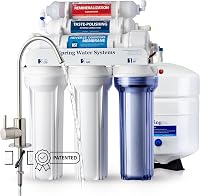
iSpring RCC7AK-BN: for households that want minerals added after RO
The iSpring RCC7AK-BN suits buyers who want dissolved-solids reduction followed by a mineral stage. Its included storage tank also makes sense when you want a reserve of filtered water ready at the faucet.
Best for mineral-conscious households.
iSpring identifies NSF/ANSI 58 certification for the entire system. It also states reductions for substances including lead, fluoride and PFAS, making this a stronger match for a defined RO treatment goal than for someone seeking only a taste change.
The faucet's top-mounted fastener is useful where the underside of the counter is awkward to reach. Quick-fitting connections and color-coordinated tubing also help organize installation.
Its filter assembly measures 15.5 in long, 16 in wide and 18 in high. Plan the complete layout with the separate tank and service access rather than treating those dimensions as the whole cabinet footprint.
The clear first-stage housing lets you see sediment buildup. Use that view as an extra maintenance clue, not a reason to delay changes until the housing looks dirty.
This system operates without electricity, which suits cabinets without a nearby outlet. Its daily production figure describes water made over time, not the amount available in one continuous pour.
Skip it if you can't make room for the tank or prefer to retain the source water's minerals without first removing them. Mineral addition is a taste and water-composition preference, not a reason to expect a health benefit.
Our reverse osmosis installation guide explains the plumbing work. For help deciding whether the extra mineral stage matters to you, read about reverse osmosis remineralization.
Waterdrop G3P600: for kitchens that need tankless RO
The Waterdrop G3P600 suits buyers who want RO without a separate storage tank and can provide under-sink power. Its faucet display puts the TDS reading and filter-life status where you draw water.
Best for busy small kitchens.
The housing measures 18.12 in long, 5.67 in wide and 17.72 in high. Its narrow width can help beside a disposal, but the length, height and filter-removal path still need checking.
Waterdrop gives an 8-second fill time for an 8 oz cup. That is a more useful serving-size reference than the daily production number when your routine involves filling drinking glasses.
The faucet's filter-life tracker helps you notice when maintenance is due. Its TDS monitor shows dissolved-solids information, but it cannot identify individual contaminants or certify that the water meets every treatment goal.
Filter changes use a twist-out, twist-in design without tools, and the system includes automatic flushing. Keep its electrical supply and plumbing arrangement consistent with the installation instructions so those functions can operate as intended.
Skip it if you lack a suitable outlet, can't accommodate the required faucet and drain openings, or want a non-electric installation. A tankless layout saves the tank footprint, but it doesn't remove the need for plumbing work.
For alternatives with the same storage approach, see our best tankless reverse osmosis systems.
Waterdrop TSU: for municipal water with a dedicated drinking faucet
The Waterdrop TSU suits a municipal-water kitchen that wants a separate filtered-water outlet while keeping dissolved minerals. It produces no wastewater and needs neither electricity nor a drain line.
Best for mineral-retaining filtration.
Waterdrop identifies reduction claims for chlorine, PFAS, taste, odor and heavy metals. Its NSF/ANSI 372 certification concerns lead-free materials, so keep that separate from the system's water-treatment claims.
The housing measures 14.81 in long, 4.68 in wide and 13.97 in high, with a maximum flow of 1.05 GPM. That combination suits buyers who want a slim unit and a dedicated outlet for drinking and cooking water.
Using a separate faucet also lets you reserve the filter for those tasks. Your main faucet can continue handling dishwashing and other jobs that don't need filtered water.
A four-light panel provides filter reminders. The filters follow different replacement schedules, so keep a record for each stage instead of replacing all three whenever one becomes due.
Skip it if you want lower TDS, use well water or can't add the required dedicated faucet. Its non-RO design is a deliberate choice for mineral retention, not a substitute for an RO system when dissolved-solids reduction is your goal.
Waterdrop 10UA: for filtering through the faucet you already have
The Waterdrop 10UA suits municipal-water buyers who want filtered cold water without adding a second faucet. It connects between a compatible cold-water supply and the existing faucet.
Best for existing-faucet setups.
At 3.9 in long, 3.6 in wide and 12.3 in high, the housing is the smallest of these four examples. Its size makes it worth considering when a tank or wider assembly would crowd the cabinet.
The twist-and-lock cartridge design simplifies removal. Check space below and around the housing so you can turn and withdraw the cartridge without disconnecting nearby plumbing.
Waterdrop identifies NSF/ANSI 42 certification, along with claims for reducing chlorine, lead, PFOA and PFOS. Confirm the scope for any named contaminant rather than assuming one certification covers the full set of claims.
Because it filters the cold-water feed to your existing faucet, routine rinsing also uses cartridge capacity. Choose it if you prefer that convenience over keeping filtered water at a separate outlet.
Skip it if you need TDS reduction, have well water or want to reserve filter use for drinking water alone. Renters should also confirm permission for plumbing changes, even when no second faucet is involved.
How should you compare flow, capacity and daily use?
Compare serving speed and usable supply, not daily production figures alone. A system's GPD figure, faucet flow and storage capacity describe different things.
Daily RO production is not faucet speed
GPD means gallons produced over a day under stated operating conditions. It does not mean that amount is ready immediately, and actual membrane output depends on factors such as incoming pressure and water temperature.
A tank system builds a reserve between uses. Once you draw heavily from that reserve, the membrane needs time to replenish it.
A tankless system makes filtered water as you draw it. For that design, a cup-fill time or outlet flow gives a clearer picture of the wait for a glass or cooking pot.
Plan around your largest regular draw
Think about what happens during the busiest few minutes in your kitchen. Filling several bottles before leaving home creates a different demand from pouring one glass every hour.
If you often fill large pots, consider where you will place them and how long you are willing to wait. A dedicated faucet can be useful for measured cooking water, but check its reach over the sink.
Direct-connect filters serve more than drinking water
An existing-faucet filter handles cold water for whatever task you use that tap to do. That can be convenient, though it may use capacity faster than a dedicated drinking faucet in the same household.
For mixed hot and cold water, the filtered cold stream blends with the separate hot supply. Use the cold setting when you want water from the filtered connection alone.
How do the filter types compare on cost and upkeep?
Compare replacement cartridges, installation work and water use together. A simple housing is only easy to live with if you can obtain the correct replacement and reach it when needed.
Build a replacement plan before buying
Find the replacement filter names and note which stages change together. The TSU's PP filter changes at 6 months, CT at 12 months and UF at 24 months.
The 10UA uses the WD-RF10 replacement cartridge and has a maximum service life of 12 months with municipal water. Higher use or difficult source-water conditions can require attention sooner, so don't treat the calendar limit as a guaranteed lifespan.
For the iSpring, match replacement sets to the stages due rather than buying by the number of years printed on a bundle. The G3P600's tracker helps with reminders, but keep your own installation and replacement dates too.
Our reverse osmosis filter life guide explains how to manage stages with different schedules.
Account for RO drain water
RO separates incoming water into filtered water and a drain stream. The G3P600's 2:1 pure-to-drain ratio means 2 cups of filtered water for each cup sent to the drain.
Do not apply that ratio to another model. When comparing systems, read the direction of the ratio carefully because filtered-to-drain and drain-to-filtered express opposite relationships.
The TSU avoids that drain stream because it uses a different filtration approach. Choose between them by treatment need first, then consider water use within the suitable options.
Include work around the filter
A new faucet opening, drain connection or suitable electrical outlet can affect the installation budget. Existing plumbing condition matters too, especially if a shutoff valve leaks or won't close.
See our reverse osmosis installation cost guide for the work that can make a plumber worthwhile.
How should you choose between tank and tankless RO?
Choose a tank for a stored reserve or tankless for a layout without a separate reservoir. Then check serving speed, service access and power needs for the exact model.
The iSpring offers a non-electric tank setup, while the G3P600 requires power. That difference can settle the decision quickly in a cabinet with no suitable outlet.
Map the complete arrangement on the cabinet floor before ordering. A tank may fit away from the filter assembly, but tubing routes and access still need to follow the installation instructions.
Avoid blocking the shutoff valve behind a tank or placing the filter where every cartridge change requires unloading the whole cabinet. A workable maintenance layout matters more than squeezing everything into the smallest possible footprint.
For a closer comparison, read our tankless vs tank reverse osmosis guide.
What should you do before installation?
Confirm connections, access and drilling requirements before opening the water line. Plan the full job, including flushing and leak checks, so the system is ready for normal use.
- Empty and inspect the cabinet. Look for existing dampness, corrosion or damaged hoses before adding new equipment.
- Check the shutoff valve. Make sure you can isolate the cold supply and know how to stop water if the valve fails.
- Confirm fittings and mounting space. Match connection sizes and leave the clearance needed to remove each cartridge.
- Plan the faucet position. Check clearance above and below the counter, including the sink bowl and mounting hardware.
- Plan the drain and power connections if required. Follow the system instructions for their location and arrangement.
- Install, flush and inspect. Use the specified startup procedure before drinking the water.
Check countertop material before drilling
An existing spare hole may help with a dedicated faucet, but confirm its size and location. Don't assume a hole left by a soap dispenser will suit every faucet assembly.
Stone, composite and metal surfaces need different tools and methods. Use a qualified installer if the drilling method or risk to the surface is unclear.
Make connections without straining the tubing
Cut and seat tubing as directed, and avoid sharp bends that pull sideways on fittings. Keep tubes clear of disposal vibration, stored bottles and cabinet doors.
Support the system using its intended mounting method. Don't leave its weight hanging from the supply hoses or faucet tubing.
Complete startup before judging the water
New filters need the flushing procedure specified for that model. Startup water can contain trapped air or loose filter media, so allow the required flush to finish before normal use.
Check every connection with the water on, then check again after drawing water. Revisit the cabinet during the first day of use rather than assuming a dry connection will stay dry without another look.
For the non-RO installation steps, use our under sink water filter installation guide.
How do you keep an under sink filter working properly?
Keep replacement dates, clean handling and leak checks in your routine. A reminder light helps, but it doesn't replace the care steps for the system.
Record each filter change
Write the installation date and the next due date where you can find them. For systems with several stages, record each cartridge separately.
Keep the exact replacement model names with that record. Similar-looking cartridges can use different connections or filter media, so appearance alone isn't enough.
Handle replacement parts carefully
Wash your hands before handling new cartridges and avoid touching exposed connection surfaces. Follow the instructions for depressurizing, opening housings and cleaning parts that contact water.
After a change, complete the required flush and inspect the seals and fittings. Don't use extra tightening as a cure for every leak, since overtightening can damage parts.
Investigate changes in flow or taste
A drop in flow can come from a loaded cartridge, a kinked tube or a partly closed valve. Check those basic causes and the replacement schedule before assuming the whole system has failed.
A taste change deserves attention even if the reminder has not appeared. Check overdue filters and follow the system's troubleshooting steps rather than masking the change with flavoring.
Plan for time away
Follow the model's storage and restart instructions before a long absence. Different cartridges need different treatment, so don't apply advice for one system to every filter.
On return, complete the required flush and check for leaks before routine use. A calendar note for restarting the system can be as useful as a replacement reminder.
Which buying mistakes are easiest to avoid?
Avoid choosing by one attractive number and overlooking the conditions that make a system useful. A high capacity, small membrane size or long filter interval answers only part of the buying decision.
- Using TDS as a safety score. It measures dissolved solids and cannot identify every substance of concern.
- Buying RO only because it has more stages. Choose it when its treatment approach matches your water and goals.
- Expecting UF to lower dissolved minerals. Select UF because you want its filtration approach while retaining them.
- Ignoring faucet permissions. A suitable filter still needs an allowed and practical installation.
- Measuring only the housing. Include the tank, tubing and cartridge-removal space.
- Treating maximum filter life as fixed. Usage and water conditions affect when a cartridge needs attention.
- Buying replacements by appearance. Use the exact compatible cartridge and follow its change procedure.
Don't buy a system as a substitute for understanding an unusual water problem. Sudden changes in color, odor or supply quality call for investigation before choosing a treatment device.
Which under sink water filter should you choose?
Choose your under sink water filter by treatment goal first, installation fit second and upkeep third. Use this decision table to turn those checks into a shortlist.
| Your situation | Start with | Pass if |
|---|---|---|
| You want RO with a mineral stage and stored water | iSpring RCC7AK-BN | The tank and service layout won't fit |
| You want RO without a separate tank | Waterdrop G3P600 | You can't provide power or its required connections |
| You have municipal water and want UF with retained minerals | Waterdrop TSU | You need TDS reduction or can't add its faucet |
| You want filtered municipal cold water at the existing tap | Waterdrop 10UA | You need RO or want a separate drinking-water outlet |
Before ordering, save the correct replacement filter names and sketch the installation inside your cabinet. Those two steps help prevent a good filtration choice from becoming an awkward system to maintain.
If the treatment choice is still unclear, start with the under sink water filter vs reverse osmosis guide and settle that question before comparing more models.
Frequently asked questions
What is the difference between an under sink filter and reverse osmosis?
Under sink describes where a filter sits; reverse osmosis describes how it filters water. Carbon and ultrafiltration systems can reduce specific substances while retaining dissolved minerals.
RO uses a membrane to reduce dissolved solids as well. Choose by the exact substances a system reduces and its installation needs.
Does an under sink water filter reduce TDS?
An under sink RO system reduces TDS, but many carbon and ultrafiltration systems do not. The Waterdrop TSU and 10UA retain dissolved minerals rather than lowering TDS.
A TDS meter measures dissolved solids, so use a water report or a contaminant-specific analysis to identify the substances you need reduced.
Do under sink water filters need electricity?
Many under sink filters run on water pressure and need no electrical outlet. The iSpring RCC7AK-BN, Waterdrop TSU and Waterdrop 10UA operate without electricity.
The tankless Waterdrop G3P600 requires under-sink power. Check the complete installation instructions before buying, since tankless describes the storage design rather than its power needs.
Can I use an under sink water filter with well water?
Use a system approved for your well water conditions and matched to a recent water analysis. The Waterdrop TSU and 10UA are not suitable for well water.
An RO membrane alone does not establish suitability; sediment, hardness and other source-water conditions can affect the treatment needed before water reaches it.
Do under sink water filters need a separate faucet?
Some use your existing faucet, while others deliver filtered water through a dedicated faucet. The Waterdrop 10UA connects to the existing cold-water supply and faucet.
The TSU and both RO systems here include separate faucets. Check for a suitable spare sink hole and confirm drilling requirements before ordering.