6 Best Reverse Osmosis Systems With Remineralization (October 2026)
The best reverse osmosis systems with remineralization include the iSpring RCC7AK-BN for first-time RO buyers, the APEC ROES-PH75 for outlet-free kitchens, and the Waterdrop G5P700A for frequent bottle filling.
On this page (11 sections)
- How we chose reverse osmosis systems with remineralization
- The best reverse osmosis systems with remineralization
- What does reverse osmosis remineralization actually change?
- How should you choose a mineral stage?
- Does your source water suit the RO system?
- Is tankless worth it for a remineralizing RO system?
- How much space and installation work should you allow?
- How should you start and care for a mineral-enhancing system?
- What do flow and drain figures mean in daily use?
- Which mistakes should you avoid?
- Which reverse osmosis remineralization system should you choose?
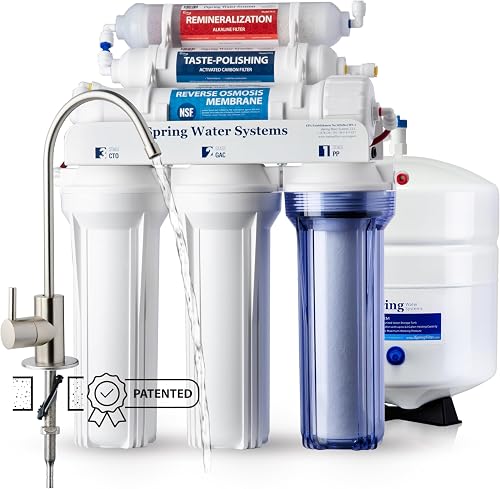
The iSpring RCC7AK-BN is our first choice for reverse osmosis remineralization when your kitchen has room for a storage tank. Its mineral stage, full-system NSF/ANSI 58 certification from iSpring and above-counter faucet fastener make it a practical starting point.
Choose APEC if you want calcium enhancement in a water-pressure-powered system. Choose Waterdrop if cabinet space favors tankless equipment, you have electrical power available, or you want separate standard RO and alkaline streams.
The right choice starts with water suitability and kitchen fit. A mineral stage changes the finished water, but it cannot make an unsuitable RO system the right match for your home.
Our picks at a glance
-
1
-
2

-
3

How we chose reverse osmosis systems with remineralization
The iSpring RCC7AK-BN ranks first for its combination of full-system certification from iSpring, mineral enhancement and installation features. We compared mineral approach, tank layout, feed-water requirements, production capacity and filter care.
The APEC options suit buyers who prefer calcium cartridges and a conventional tank setup. Waterdrop offers different reasons to go tankless: higher production capacity, a choice of water streams, or automatic flushing with maintenance alerts.
We gave more weight to useful differences than stage counts. A system with more named stages does not automatically fit your water or kitchen better.
For wider options, see our best under-sink reverse osmosis systems. If your main concern is taste and you haven't settled on RO, compare under-sink water filters and RO systems.
| Product | Best for | Design | Capacity | Mineral stage | Our score |
|---|---|---|---|---|---|
| iSpring RCC7AK-BN | first-time RO buyers | Tank system | 75 GPD | Natural mineral AK | 9.3 |
| APEC ROES-PH75 | outlet-free kitchens | Tank system | 75 GPD | Calcium | 8.6 |
| Waterdrop G5P700A | frequent bottle filling | Tankless | 700 GPD | Multi-mineral blend | 7.7 |
| Waterdrop WD-T4-A | mixed taste preferences | Tankless | 450 GPD | Separate alkaline stream | 7.5 |
| APEC ROES-PH75X | planned filter changes | Tank system | 75 GPD | Calcium | 7.3 |
| Waterdrop T3-M | reminder-led upkeep | Tankless | 450 GPD | Calcium, magnesium and other minerals | 7.1 |
The best reverse osmosis systems with remineralization
Choose iSpring for a first tank installation, APEC for calcium enhancement, or Waterdrop for a tankless layout. The individual picks below explain which buyers gain something useful from each design and when to choose another option.
1. iSpring RCC7AK-BN: our top reverse osmosis remineralization pick
iSpring RCC7AK-BN: Best for first-time RO buyers
- 6-stage filtration
- Natural mineral AK stage
- Full-system NSF/ANSI 58 certification from iSpring
- 75 GPD
A tank-based choice for buyers who want mineral enhancement and a faucet fastener that tightens from above. iSpring states that NSF/ANSI 58 certification covers the full RO system.
Pros
- Full-system NSF/ANSI 58 certification from iSpring
- Top-mounted faucet fastener
- Transparent first-stage housing
Cons
- Separate tank takes cabinet space
- Housing visibility does not replace a filter schedule
The iSpring RCC7AK-BN suits first-time RO buyers who want full-system certification and practical installation help. iSpring states that NSF/ANSI 58 certification covers the complete system, rather than only an individual component.
Its 6-stage design includes a natural mineral AK stage and a storage tank. The top-mounted faucet fastener tightens from above the counter, which helps when reaching behind a deep sink would be awkward.
Quick-fitting connections, color-coordinated tubing and installation videos give a DIY installer useful guidance. The unit operates without electricity, so an unavailable cabinet outlet does not rule it out.
The transparent first-stage housing lets you spot visible sediment buildup. Keep a dated filter schedule too, since appearance cannot show the remaining life of every filter.
Skip this model if the tank would block your shutoff valves, waste bin or service access. Its faucet fastener eases one task, but you still need to plan the feed connection, drain connection and tubing routes.
Our iSpring RCC7AK-BN review looks more closely at this model's fit and features.
2. APEC ROES-PH75: calcium enhancement without an outlet
APEC ROES-PH75: Best for outlet-free kitchens
- 6-stage filtration
- Calcium mineral cartridge
- 75 GPD
- WQA certification from APEC
This water-pressure-powered system suits kitchens with tank space and no convenient electrical outlet. Its calcium cartridge provides a focused alternative to a multi-mineral stage.
Pros
- Calcium mineral cartridge
- Water-pressure powered
- Tank and installation fittings included
Cons
- Needs separate tank space
- No separate standard RO stream
The APEC ROES-PH75 suits buyers who want a calcium-focused mineral stage without electrical power. APEC uses a calcium cartridge for pH enhancement and describes the system as WQA certified.
This is a conventional tank setup, so stored water serves the faucet while the membrane replenishes the supply. That arrangement fits kitchens where cabinet space is easier to spare than access to an outlet.
APEC specifies feed pressure of 40–85 psi and a maximum feed-water TDS of 2,000 ppm. Check both before buying; those limits describe acceptable supply conditions, not a promise of equal output throughout the range.
The filter assembly measures 15.5 x 5.25 x 17.5 in, with a separate 11 in wide, 15 in high tank. Leave extra room for tubing and filter service rather than squeezing both into a tight gap.
Skip it if you want to switch between standard RO water and mineral-enhanced water at the faucet. For a closer choice between the leading tank models, read our iSpring RCC7AK-BN vs APEC ROES-PH75 comparison.
3. Waterdrop G5P700A: a tankless choice for frequent filling
Waterdrop G5P700A: Best for frequent bottle filling
- 8-stage filtration
- Calcium, magnesium, sodium and potassium
- 700 GPD
- 2:1 pure-to-drain ratio
The highest-capacity option here suits households that frequently fill bottles and pitchers. Check its feed-water limits, electrical needs and faucet installation before choosing it.
Pros
- No separate storage tank
- Multi-mineral enhancement
- 2:1 pure-to-drain ratio
Cons
- Requires electrical power
- Maximum supported feed-water TDS is 500 ppm
The Waterdrop G5P700A suits households that fill bottles and pitchers often and want to avoid a separate storage tank. Its 700 GPD production rating is the highest in this group.
The mineral stage adds calcium, magnesium, sodium and potassium. Choose it for that water profile and its layout, rather than assuming that a longer mineral list means a better result for every drink.
Feed-water compatibility deserves attention here: Waterdrop specifies a maximum TDS of 500 ppm and pressure of 14.5–87 psi. A high production rating does not override those limits.
The body measures 16.69 x 5.69 x 13.9 in. Check its placement around the sink bowl, then reserve access for its cord, connections and filter changes.
Waterdrop also supports connections to appliances through Waterdrop XT. Plan that as a separate connection project rather than assuming every fridge hookup is included.
Skip it if you lack power or your source water falls outside its supported conditions. Our best tankless reverse osmosis systems guide covers more choices if this model's limits don't suit your home.
4. Waterdrop WD-T4-A: different water options for one household
Waterdrop WD-T4-A: Best for mixed taste preferences

- 10-stage filtration
- Separate RO and alkaline streams
- 450 GPD
- Filter lights and buzzer alerts
Choose between standard RO water and a mineral-enhanced alkaline stream at the faucet. This flexibility suits households whose members prefer different water tastes.
Pros
- Choice of standard RO or alkaline water
- Filter lights and buzzer alerts
- 2:1 pure-to-drain ratio
Cons
- Requires electrical power
- Separate mineralizer has its own replacement interval
The Waterdrop WD-T4-A is the clearest choice when people in your home prefer different water tastes. It provides a standard RO stream and a separate mineral-enhanced alkaline stream.
That choice also helps if you want to compare how each stream tastes in tea or drinking water. You can select the stream for each use instead of committing the entire household to mineral enhancement.
The benefit comes with another service item to track. Waterdrop gives replacement intervals of 6 months for the CF filter, 12 months for the CB filter and alkaline mineralizer, and 24 months for the RO membrane.
Indicator lights and buzzer alerts help you follow that schedule. Keep your own installation dates so you can track the work even after an alert has been reset.
At 16.54 x 6.22 x 17.95 in, it needs a clear vertical space as well as an electrical connection. Skip it if everyone wants the same mineral-enhanced water, because its main advantage is the choice between streams.
5. APEC ROES-PH75X: a bundle for planned maintenance
APEC ROES-PH75X: Best for planned filter changes

- 6-stage filtration
- Calcium mineral cartridge
- 75 GPD
- Extra stages 1–3 prefilter set
This bundle suits buyers who want the next prefilter set ready when maintenance comes due. The extra filters cover stages 1–3, rather than every stage.
Pros
- Extra stages 1–3 prefilters
- Calcium mineral cartridge
- Water-pressure powered
Cons
- Needs separate tank space
- Extra set excludes the membrane and mineral cartridge
The APEC ROES-PH75X suits buyers who want the next prefilter change ready in advance. Its extra set covers stages 1–3, and APEC recommends changing those prefilters every 6 months.
The underlying reason to choose this design remains its calcium mineral cartridge and water-pressure-powered tank layout. The bundle adds maintenance supplies; it does not add another mineral option or a separate water stream.
Store the spare filters sealed in a clean, dry place according to their instructions. Label them for this system so they don't get mixed with cartridges for another appliance.
The included extras do not replace the RO membrane or mineral cartridge. Plan those service items separately rather than treating one spare set as a complete future overhaul.
APEC describes this system as WQA certified and specifies the same feed-pressure range as the ROES-PH75. Your installation still needs room for both the filter assembly and tank.
Skip the bundle if you prefer ordering filters when due or have limited storage. Choose it when keeping compatible prefilters ready will help you stay on schedule.
6. Waterdrop T3-M: automatic flushing with service reminders
Waterdrop T3-M: Best for reminder-led upkeep

- 9-stage filtration
- Calcium and magnesium infusion
- 450 GPD
- Automatic flushing and filter alerts
Automatic flushing and filter alerts help organize routine care in this mineral-enhancing tankless system. Its shorter cabinet depth may help where plumbing limits placement.
Pros
- Automatic flushing
- Filter replacement alerts
- 2:1 pure-to-drain ratio
Cons
- Requires electrical power
- No separate standard RO stream
The Waterdrop T3-M suits buyers who want automatic flushing and alerts to guide routine care. Its mineral infusion includes calcium and magnesium, with no separate standard RO stream.
The body is 13.39 x 6.22 x 17.95 in. That shorter depth may help where plumbing leaves a shallow usable space, but check the height beneath your sink bowl before choosing a position.
Waterdrop gives service intervals of 6 months for the CF filter, 12 months for the CB filter and 24 months for the RO filter. These are separate tasks, so one completed change does not reset the age of the others.
Automatic flushing handles a system function; it does not remove the need to replace filters or clean equipment as instructed. Leave the power and drain arrangements ready for normal operation.
Choose this model when its dimensions and care features solve your main needs. Skip it if you want selectable water streams, or if fitting a powered unit would require more cabinet changes than a tank system.
What does reverse osmosis remineralization actually change?
Remineralization adds minerals after RO filtration, changing the finished water's taste and chemistry. It serves a different purpose from the membrane, which reduces dissolved substances as water passes through it.
Mineral media can affect pH, but pH and mineral content are different measures. Neither tells you by itself which contaminants an RO system reduces.
Taste is the most useful everyday reason to consider this feature. If you find plain RO water flat, a mineral stage gives you another water profile to consider.
Don't choose by the highest alkaline claim or expect a fixed mineral dose from every glass. Media design, incoming water, flow and cartridge age can affect the finished result.
The products here do not provide a shared mineral-output figure for direct comparison. Choose the mineral approach you prefer, then give more weight to compatibility, service access and the water options you'll use.
How should you choose a mineral stage?
Choose calcium enhancement, a mineral blend or selectable streams according to how you want to use the water. None of those approaches makes the other installation checks less important.
A calcium-focused cartridge is a clear choice if you want that particular approach without seeking several named added minerals. A blend suits buyers who prefer a broader mineral profile, but the number of minerals isn't a quality score.
Selectable streams are useful when preferences differ or you want standard RO water available for certain drinks. If everyone will use mineral-enhanced water every time, that extra choice may add little value.
Remineralization also does not give you precise control over beverage recipes. If you need an exact mineral composition for a particular use, a general-purpose mineral cartridge is a poor substitute for measured water preparation.
Avoid choosing a system for promises about hydration, bones or other health outcomes. Buy the mineral stage for its practical water options and taste role.
Does your source water suit the RO system?
Check feed-water limits and relevant contaminant reductions before mineral features. A system must suit the water entering it before its finishing stage becomes useful.
For municipal water, start with your supplier's water-quality report and any known plumbing concerns. For a private well, get a current water analysis and plan treatment around the results.
Don't assume every under-sink RO unit handles untreated well water on its own. Sediment, hardness and other source-water conditions can create needs beyond a drinking-water system's job.
Certification scope matters too. NSF/ANSI 372 concerns lead content in materials; it does not establish broad contaminant-reduction performance, while NSF/ANSI 58 addresses RO systems and can include specific reduction claims.
Match the exact model's certification coverage to the substance you need reduced. A general purity percentage is less useful than information about that particular concern.
For a step-by-step selection process, use our guide to choosing a reverse osmosis system for your kitchen.
Is tankless worth it for a remineralizing RO system?
Choose tankless when removing a separate storage tank improves your cabinet layout and you can provide power. Choose a tank system when outlet-free operation and stored water fit your needs better.
A tank system holds filtered water for use while the membrane refills it. A tankless unit produces water on demand, so the two designs serve a sudden filling task differently.
Don't compare them only by GPD. That number describes daily production under specified conditions, not the amount that will instantly leave your faucet.
Make a list of your busiest uses: breakfast drinks, several bottles before school, or a large pitcher for dinner. Consider those short periods of demand alongside total daily use.
Tankless also doesn't mean the whole cabinet becomes free. The unit, plumbing, electrical connection and service space still occupy room.
Our tankless vs tank reverse osmosis comparison explains the layout and use tradeoffs if you're still split between them.
How much space and installation work should you allow?
Allow room to service the system, not just enough space to fit its body. You should be able to reach shutoff valves, inspect connections and replace filters without dismantling the cabinet.
Measure usable space with the doors closed. Account for the sink bowl, disposal, drain trap, shelf edges and any pull-out bin.
For a tank setup, plan the tank and filter assembly as separate objects. Leave tubing with gentle bends and enough access to remove housings as the instructions require.
For a powered system, locate a suitable outlet and keep the plug accessible. Don't assume an outlet used by a disposal provides continuous power.
Waterdrop calls for countertop drilling for the faucets on all 3 models here. Confirm the hole requirements and countertop material before arranging the work; drilling should never be a surprise on installation day.
Read our reverse osmosis installation guide to plan the feed connection, drain line, faucet position and initial startup.
How should you start and care for a mineral-enhancing system?
Follow the exact startup and flushing sequence before drinking the water. Installing cartridges and connecting tubing does not complete commissioning.
Read the instructions before opening the supply valve, then check each connection as directed. Keep the cabinet clear during startup so small leaks are easy to spot.
Flush new filters and mineral media for the specified amount of time or water volume. Don't shorten the process because the first glass looks clear.
Record the installation date and each cartridge's due date. Prefilters, carbon stages, membranes and mineral cartridges do different jobs and rarely share one replacement schedule.
Keep replacement parts matched to the exact model. A cartridge with the right general purpose is not automatically compatible with the fittings, flow direction or housing.
Follow the maker's sanitizing and restart instructions after service or a long period away. Our guide to how long reverse osmosis filters last explains why service timing varies between stages.
What do flow and drain figures mean in daily use?
Use capacity and drain ratios as planning figures, then consider the conditions in your home. Feed pressure, water temperature and membrane condition can affect actual production.
A large daily capacity is useful when demand is frequent, but it does not mean you need the highest number available. Match the design to how you draw water throughout the day.
All 3 Waterdrop models here specify a 2:1 pure-to-drain ratio. That means 2 parts purified water for each part sent to the drain under the stated operating conditions.
It does not mean the system has no wastewater. Startup flushing, automatic flushing and use patterns can also affect the amount sent to the drain.
Avoid comparing drain efficiency across every pick when equivalent figures aren't available for all of them. Confirm operating requirements first, then weigh efficiency alongside fit and filter care.
Which mistakes should you avoid?
Avoid using taste, pH or a TDS reading as proof of water safety. Each can tell you something about the water, but none identifies every substance that might concern you.
A mineral stage can raise TDS after the membrane has reduced it. Don't treat that final increase alone as a membrane fault, and don't assume a low reading proves the absence of a specific contaminant.
Another mistake is treating every stage as an equally important reason to buy. Count the functions you need rather than rewarding the longest stage list.
Don't assume a spare prefilter bundle includes a replacement mineral cartridge. Check the actual service parts and plan a full maintenance cycle before ordering.
Finally, avoid adding an unrelated mineral cartridge simply because its tubing appears to fit. If you're modifying an existing system, confirm compatibility, placement and flushing instructions with the system manufacturer.
Which reverse osmosis remineralization system should you choose?
Choose the iSpring RCC7AK-BN when you want a first tank system with installation features that help in a crowded sink area. Choose the APEC ROES-PH75 when calcium enhancement and outlet-free operation suit your kitchen.
Pick the APEC ROES-PH75X if keeping the next prefilter set ready will improve your maintenance routine. The bundle makes sense for that convenience, rather than as a different approach to mineral enhancement.
For tankless reverse osmosis remineralization, choose the G5P700A for frequent filling, the WD-T4-A for differing water preferences, or the T3-M when its dimensions and care reminders fit best.
Before ordering, settle 3 things: whether your source water is suitable, whether you can service the installed unit, and whether you want minerals in every glass. Use our reverse osmosis installation guide to turn that choice into a workable kitchen plan.
Our top 3 picks at a glance
-
1
-
2
-
3
Frequently asked questions
What does remineralization do in a reverse osmosis system?
Remineralization adds minerals after RO filtration, mainly to change taste and water chemistry. Calcium cartridges and mineral blends take different approaches, while a dual-stream design lets you choose water without the added mineral stage.
Added minerals do not replace contaminant removal or establish a health benefit.
Do reverse osmosis systems with remineralization need electricity?
Some need electricity, while others run on water pressure. The iSpring and APEC tank systems here do not need an electrical connection; all 3 Waterdrop tankless choices do.
Check outlet placement before ordering, and allow room to reach the plug and service the unit.
Should I choose a tank or tankless RO system with minerals?
Choose a tank system when you have cabinet space and want an option that runs without electricity. Choose tankless when avoiding a separate storage tank matters more.
Compare your peak filling needs, cabinet layout and power access rather than choosing from the daily production number alone.
How often do remineralization filters need replacing?
Replace the mineral stage on its own model-specific schedule, rather than using the membrane's interval. Waterdrop gives the WD-T4-A alkaline mineralizer a 12-month interval.
Other cartridges have separate schedules, and water use and feed-water conditions can affect service needs. Record each filter's installation date and follow its instructions.
Will a TDS meter show whether remineralization is working?
A TDS meter can show a change in dissolved substances, but it cannot identify individual minerals or prove water safety. A mineral stage can raise the reading after RO filtration.
Compare readings at the correct points and follow the system's guidance rather than judging performance from the final faucet reading alone.