iSpring RCC7AK Review: Worth It? (October 2026)
The iSpring RCC7AK-BN suits households that want mineral-added RO water without an electrical connection. Choose it if your cabinet can hold a storage tank and you want a faucet that tightens from above the counter.
On this page (8 sections)
- Who should buy the iSpring RCC7AK?
- What do its filtration claims mean for your water?
- How much water and cabinet space should you plan for?
- Which alternative fits your kitchen better?
- What should you check before installing the RCC7AK-BN?
- How should you care for the filters and tank?
- Which common mistakes should you avoid?
- Should you choose the iSpring RCC7AK-BN?
The iSpring RCC7AK-BN is a good choice for households that want mineral-added RO drinking water without an electrical connection. Buy it if you can spare cabinet space for a storage tank and want a faucet that secures from above the counter.
Its main trade-off is space and upkeep: you'll need room for the components and access for regular filter changes. A tankless system makes more sense in a crowded cabinet, while standard RO suits buyers who don't want minerals added back.
Who should buy the iSpring RCC7AK?
Choose the RCC7AK-BN for daily drinking and cooking water with an added mineral stage. It fits a kitchen where you can leave the system installed, maintain its filters and give the storage tank a permanent spot.
iSpring RCC7AK-BN: Best for everyday drinking water
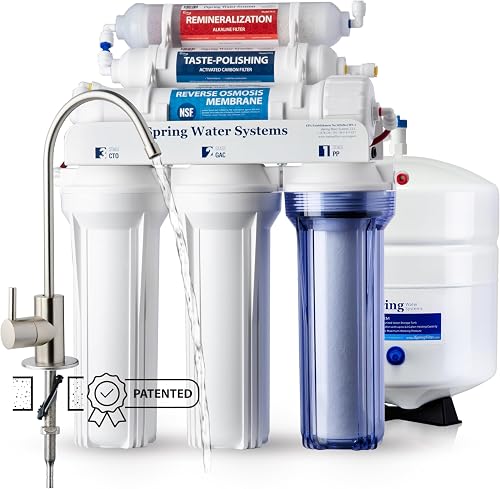
- 75 GPD capacity
- 6-stage filtration
- Natural mineral AK stage
- Top-mounted faucet fastener
A tank-based choice for households that want mineral-added drinking water without electricity. Its faucet tightens from above the counter, and the clear first housing lets you check sediment buildup.
Pros
- NSF/ANSI 58 certification for the full system
- Mineral AK stage
- Faucet secures from above the countertop
- Transparent first-stage housing
Cons
- Storage tank needs cabinet space
- Mineral stage adds another replacement task
This is a point-of-use system for the kitchen, so plan around the water you drink or use in food preparation. It doesn't replace treatment for every tap in the house.
The faucet design is useful when the back of your sink is hard to reach. Securing it from above removes one awkward mounting task, although the water and drain connections still happen below.
Skip this model if you need nearly all your cabinet space for storage. Also skip it if you want RO water without an added mineral cartridge, since the simpler RCC7-BN better matches that preference.
What does the iSpring RCC7AK-BN mineral stage add?
The AK stage adds minerals after RO filtration. It suits buyers who prefer mineral-added water, but it isn't a reason to expect a health benefit from higher pH.
Taste is personal, and the mineral stage doesn't promise a particular flavor in every home. Don't choose it expecting water to taste exactly like a favorite bottled brand.
The extra cartridge also becomes part of your care routine. Our guide to reverse osmosis systems with remineralization explains how this step fits into an RO system.
What do its filtration claims mean for your water?
Match the RCC7AK-BN to the substances you need to reduce, rather than the number of filter stages alone. iSpring certifies the entire system to NSF/ANSI 58 and reports reductions for contaminants including lead, fluoride, PFAS and chlorine.
iSpring reports TDS reduction of 93–98% and lead reduction above 98.9%. Those figures describe reductions under specific conditions, so don't use them to predict an exact result from an unknown water supply.
Start with your utility's water quality report if you use municipal water. For a private well, get a water analysis before deciding which treatment equipment belongs ahead of a kitchen RO system.
A kitchen RO unit shouldn't be your only response to an unknown well-water problem. Source-water conditions may call for separate treatment before water reaches the RO filters.
Why isn't a low TDS reading the whole answer?
A TDS meter measures dissolved solids, not each individual contaminant. A low reading can't tell you whether a specific substance, such as lead, is below your target level.
Added minerals can also raise the reading after the AK cartridge. Comparing that water directly with plain RO water can make the mineral stage look like a filtration problem when it is doing its intended job.
If you're tracking membrane performance, follow iSpring's guidance on where to take readings. Use a contaminant-specific analysis when you need an answer about a particular substance.
How much water and cabinet space should you plan for?
Treat the 75 GPD figure as daily production capacity, not the amount waiting in the tank or an instant faucet flow rate. Tank-based RO makes water over time and stores it for later use.
Cold feed water and lower pressure can slow RO production. A household that fills several large containers in a row should think about refill time, not just its total daily drinking-water use.
| Detail | iSpring RCC7AK-BN |
|---|---|
| Filtration | 6 stages, including the mineral AK stage |
| Power | No electricity required |
| Supplied faucet | Brushed nickel |
| Storage | Tank included |
| Dimensions provided for the system | 15.5 x 16 x 18 in |
| Feed adapter | 1/2 in NPT and 3/8 in compression compatibility |
| Replacement sets | F4AK, F9K, F19K75 and F28K75 |
Don't use the system dimensions as a complete cabinet-fit plan. Check the tank's dimensions separately and leave room for tubing bends, shutoff access and removing filter housings.
Measure around the sink bowl, disposal and drain pipes. A unit that fits through the cabinet door can still be difficult to service once installed.
For a wider look at layouts, see our best under-sink reverse osmosis systems. Compare usable space and service access before choosing by capacity.
Which alternative fits your kitchen better?
Choose an alternative when cabinet space or mineral preference matters more than the RCC7AK-BN's combination of features. These 3 options solve different needs.
APEC ROES-PH75: for buyers who want added calcium
The APEC ROES-PH75 suits buyers who specifically want a calcium mineral cartridge in a tank-based system. APEC identifies it as WQA certified, and it runs on water pressure.
Its feed-water range is 40–85 psi, with a maximum supported TDS level of 2,000 ppm. Check both against your supply before making it your alternative.
The filter assembly measures 15.5 x 5.25 x 17.5 in, while its tank is 11 in wide and 15 in high. Skip it if you need to eliminate a separate tank or your supply falls outside its requirements.
Our iSpring RCC7AK vs APEC ROES-PH75 comparison helps you weigh these two mineral-added choices.
Waterdrop G5P500A: for cabinets that can't spare tank space
The Waterdrop G5P500A suits crowded cabinets with a suitable electrical connection. Its tankless body measures 16.69 x 5.69 x 13.9 in, so you can plan its footprint without finding a separate tank location.
Its 2:1 pure-to-drain ratio means 2 parts purified water for each part sent to the drain. That is useful for comparing water use, but it isn't an efficiency figure you can apply to the iSpring models.
Waterdrop specifies a maximum feed-water TDS of 500 ppm. Skip this model if your water exceeds that limit or you can't provide the required power and faucet installation.
Our tankless vs tank reverse osmosis comparison explains how the layouts affect daily use.
iSpring RCC7-BN: for buyers who don't want added minerals
The RCC7-BN is the better fit if you want RO filtration without a mineral stage. It keeps the top-mounted faucet design and works without electricity.
Choosing it removes the AK cartridge from your replacement routine. That is a useful simplification if added minerals aren't part of your buying goal.
It still needs space for a tank-based layout. Skip it if saving that space is your main reason for replacing an existing system.
What should you check before installing the RCC7AK-BN?
Confirm water pressure, component fit and faucet placement before connecting anything. The faucet fastener simplifies mounting, but it doesn't remove the need to plan the plumbing.
Check the current iSpring manual for the full allowable feed-pressure range. A single pressure figure isn't enough to judge a home with weak flow or large pressure swings.
Next, identify the cold-water shutoff and confirm the feed adapter matches your connection. Don't force fittings that appear close in size.
Check whether an existing sink opening is suitable for the dedicated faucet. If a new hole is needed, have someone familiar with the countertop material handle that step.
Lay out the filter assembly and tank before cutting tubing. Keep tubing clear of sharp edges, hot surfaces and items that could pinch it when you close the cabinet.
The system uses color-coded tubing and push-to-connect fittings. Make square, clean tube cuts, seat each connection as directed and check that nothing pulls against a fitting.
Follow the specified drain-connection location and local plumbing requirements. Our reverse osmosis installation guide can help you prepare for the full job.
After connecting the system, follow iSpring's startup and flushing instructions before drinking the water. Check every connection as the system fills, then check again after it has remained under pressure.
How should you care for the filters and tank?
Maintain the RCC7AK-BN by following each stage's service schedule and keeping access clear. A calendar reminder and a simple change log make this easier than relying on taste alone.
The replacement sets carry different time labels: F4AK for 6 months, F9K for 1 year, F19K75 for 2 years and F28K75 for 3 years. These are set labels, not permission to leave every component unchanged for the longest interval.
Record which filters you replace and the date. Keep the next service date beside that record, since different stages may be due at different times.
The transparent first housing lets you see sediment buildup between changes. Clear-looking water inside it doesn't tell you how much life remains in the carbon filters or membrane.
Before service, shut off the supply and relieve pressure as instructed. Keep replacement parts clean, inspect seals and follow the manual's sanitizing and flushing steps.
Our guide to how long reverse osmosis filters last explains why source water and use affect replacement timing.
If flow drops, check whether the tank has had time to refill and whether filters are due. Tank air pressure can also affect delivery, but follow the correct empty-tank procedure before measuring or adjusting it.
Which common mistakes should you avoid?
Avoid choosing by stage count, ignoring service space and expecting instant refills. These mistakes can leave you with the wrong system even when its filtration features match your goals.
- Counting stages as a quality ranking. More stages can mean a different treatment step, such as adding minerals, rather than broader contaminant reduction.
- Packing storage around the filters. Leave enough clearance to remove housings and reach shutoffs without emptying the whole cabinet.
- Treating the tank as unlimited storage. Back-to-back pitcher fills can use the stored supply before the system replenishes it.
- Waiting for a taste change to replace filters. Taste isn't a complete measure of filter condition or contaminant reduction.
- Connecting a refrigerator without planning the line. iSpring supports connections to most fridges with its optional ICEK kit, but the route and appliance requirements still need checking.
Budget for replacement parts and any plumbing work along with the system itself. Our guide to choosing a reverse osmosis system helps you check those needs before ordering.
Should you choose the iSpring RCC7AK-BN?
Choose the iSpring RCC7AK-BN if you want mineral-added water, can fit the tank and have room to maintain the filters. Confirm the cabinet layout and feed-pressure requirements first, since those decide whether it belongs in your kitchen.
Pick the APEC ROES-PH75 for its calcium cartridge when your supply meets its requirements. Choose the Waterdrop G5P500A when removing the storage tank matters most and you can supply power.
Choose the RCC7-BN if you prefer to skip added minerals and the extra cartridge. For other configurations within the brand, see our best iSpring reverse osmosis systems.
Frequently asked questions
Is the iSpring RCC7AK-BN NSF certified?
iSpring certifies the entire RCC7AK-BN system to NSF/ANSI 58. Match the system's certified reduction claims to the substances you want to address in your water, rather than choosing by the certification name alone.
Your local water report or a water analysis can help identify those priorities.
Does the iSpring RCC7AK-BN need electricity?
The iSpring RCC7AK-BN operates without electricity, using water pressure and a storage tank. You still need suitable feed pressure, a cold-water connection, a drain connection and room for the components.
Check the manual's pressure requirements before installation, especially if your kitchen tap already has weak flow.
What is the difference between the RCC7AK-BN and RCC7-BN?
The RCC7AK-BN adds a mineral AK stage after RO filtration, while the RCC7-BN has no added mineral stage. Both have a 75 GPD capacity and a top-mounted faucet fastener.
Choose the AK model for mineral-added water, or the standard model if you prefer to skip that extra cartridge.
How often do RCC7AK-BN filters need replacement?
Follow iSpring's schedule for each filter stage, with adjustments for water conditions and use. Replacement sets have 6-month, 1-year, 2-year and 3-year labels, but those aren't interchangeable service intervals for every filter.
Record each change and use the transparent housing to watch sediment buildup between scheduled replacements.