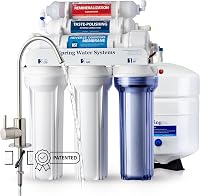
iSpring RCC7AK-BN vs APEC ROES-PH75: Which Is Better? (October 2026)
For APEC vs iSpring, choose the iSpring RCC7AK-BN for easier faucet mounting and visible sediment buildup. Choose the APEC ROES-PH75 if you prefer a calcium mineral stage and its stated pressure range fits your supply.
On this page (11 sections)
- APEC vs iSpring: which system should you choose?
- Will either system fit beneath your sink?
- What does 75 GPD mean for daily use?
- Which certification details matter for your water?
- How do their filtration claims compare?
- What do the mineral stages change?
- Which system is easier to install?
- How should you check water pressure before buying?
- What filter care will each system need?
- Which buying mistakes should you avoid?
- APEC vs iSpring: the final decision
For APEC vs iSpring, choose the iSpring RCC7AK-BN when faucet access and visible sediment buildup matter most, or the APEC ROES-PH75 when you prefer a calcium mineral stage. Both are 75 GPD, 6-stage under-sink reverse osmosis systems with separate storage tanks.
The better choice is the one that fits your cabinet, water supply and upkeep routine. Neither brand name should outweigh a poor fit beneath your sink.
If you're still deciding whether RO suits your kitchen, start with our guide to under-sink reverse osmosis systems. For a broader comparison of filtration types, see under-sink water filters and RO systems.

APEC vs iSpring: which system should you choose?
Choose iSpring for easier faucet mounting and a clear sediment housing; choose APEC for its calcium cartridge if its plumbing requirements suit your home. These differences are more useful than comparing the shared stage count.
APEC vs iSpring by buyer and kitchen
The iSpring suits a homeowner whose sink bowl or disposal makes reaching the faucet nut difficult. Its fastener tightens from above, removing one awkward task from the installation.
It also suits someone who checks beneath the sink regularly and wants to see sediment collecting in the first housing. That view helps with routine checks, though it cannot replace a filter schedule.
APEC suits a buyer who specifically wants calcium added after RO filtration. Its defined feed-pressure range also gives you a clear requirement to compare with your home's measured supply.
Skip either model if you cannot make space for a tank, reach the filters for service or obtain approval for plumbing changes. Renters should settle those questions before ordering.
The key differences at a glance
| Feature | iSpring RCC7AK-BN | APEC ROES-PH75 |
|---|---|---|
| Mineral stage | Natural mineral AK stage | Calcium mineral cartridge |
| Certification statements | iSpring states full-system NSF/ANSI 58 certification | APEC states WQA certification and cites NSF 372 and 58 |
| Faucet installation | Top-mounted fastener | Included faucet |
| First-stage visibility | Transparent housing | No transparent-housing feature specified |
| Pressure information | Single 70 psi figure; confirm full range | 40–85 psi |
| System dimensions, L x W x H | 15.5 x 16 x 18 in | 15.5 x 5.25 x 17.5 in |
Use these differences to narrow your choice, then check the installation instructions for the exact model. A narrow filter assembly can still be a poor fit once the tank and service clearance are included.
Will either system fit beneath your sink?
Both need space for the filter assembly, tank and filter changes. Measure usable cabinet space around the plumbing rather than relying on the cabinet's outer width.
APEC's tank measures 11 in wide and 15 in high. Confirm the iSpring tank dimensions before ordering if clearance is tight.
Make a simple footprint with cardboard or paper for each major part. Place those shapes around the disposal, drain trap and supply valves to see whether everything has a workable position.
Leave access to the shutoff valve and enough room to remove filter housings. A system that fits only after you block a valve or wedge a housing against a pipe will be difficult to maintain.
Tubing also needs gentle bends and protection from drawers, cleaning bottles and cabinet doors. Avoid a layout that depends on crushing tubing behind the tank.
For a cabinet already crowded by a disposal and pullout bins, consider a different layout before choosing either model. Our tankless vs tank reverse osmosis comparison explains the space and use tradeoffs.
What does 75 GPD mean for daily use?
The shared 75 GPD figure describes daily production, not faucet speed. A storage tank supplies water for immediate use while the membrane makes more water over time.
For ordinary drinking, coffee and cooking, think about your busiest draw rather than total household water use. Filling several bottles and a large cooking pot together places a different demand on storage than filling occasional glasses.
A full tank can serve a short burst of use, but repeated large draws leave less stored water available. Cold feed water and low supply pressure can also slow RO production.
Neither model's daily capacity tells you how quickly it will refill under your kitchen's conditions. If back-to-back pitcher fills are central to your routine, confirm usable tank capacity and refill expectations before buying.
An under-sink RO system serves a drinking-water point rather than every tap in the house. Do not size it as though it will filter showers, laundry or all kitchen cleaning water.
Which certification details matter for your water?
Choose by certification coverage for your water concern, rather than treating a certification logo as a universal promise. The standard, exact model and named reduction claims all matter.
iSpring states NSF/ANSI 58 certification for the entire filtration system. APEC states WQA certification and references NSF 372 and 58.
WQA is a certification organization, while the NSF/ANSI numbers identify standards. NSF/ANSI 58 concerns RO systems; NSF/ANSI 372 concerns lead content in materials, rather than proving lead-removal performance.
Confirm that certification records match the model you intend to buy. If lead, arsenic or another specific substance drives your decision, look for that reduction claim within the model's certification scope.
For municipal water, begin with your utility's water-quality report. For a private well, use a current water-quality analysis to identify concerns and any treatment needed before an under-sink system.
Do not choose either model as a complete answer to an unknown well-water problem. Sediment, hardness and microbial concerns may call for separate treatment, depending on the water analysis.
How do their filtration claims compare?
Both brands claim broad contaminant reduction, but their headline figures do not establish a winner for every water supply. Compare the substance you want reduced, rather than the largest percentage.
iSpring claims reductions of 93–98% for TDS, 96–99% for PFAS and 95–99% for chlorine. It also names reductions for substances including lead, fluoride, chromium and cadmium.
APEC claims up to 99% reduction of impurities including chlorine, VOCs, fluoride, arsenic, lead and heavy metals. It specifies a maximum feed-water TDS of 2,000 ppm.
An “up to” claim is not a promise that every named substance falls by that amount in every home. Feed-water conditions, pressure and filter condition affect how an RO system operates.
A TDS meter can help track changes in dissolved solids, but it cannot identify individual contaminants. A low reading is not proof that a specific concern has been addressed.
Use contaminant-specific information for the buying decision and follow the system's care instructions afterward. Taste alone is also a poor measure of contaminant reduction.
What do the mineral stages change?
The mineral stages add minerals after RO filtration and can affect taste and pH. They are a preference feature, rather than a reason to expect a health benefit.
iSpring says its AK stage adds multiple minerals and adjusts pH. APEC says its calcium cartridge adds calcium and raises pH.
Pick APEC if calcium is the particular mineral-stage feature you want. Pick iSpring if you prefer its broader mineral-stage approach alongside its installation features.
Neither description gives a dependable prediction of the exact finished-water pH or flavor in your kitchen. Starting water and cartridge condition can affect the result.
If you mainly want RO for a specific contaminant, solve that requirement first. Mineral preference should help break a tie after cabinet fit and water compatibility are settled.
Which system is easier to install?
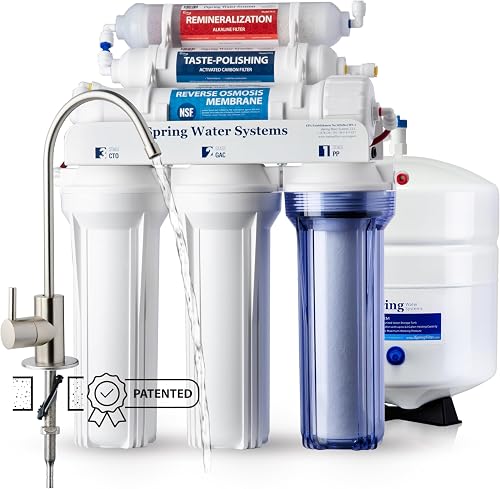
The iSpring has the clearer faucet-mounting advantage when reaching beneath the counter is difficult. Its quick-fitting connections, color-coordinated tubing and installation videos also support a DIY setup.
It includes a brushed nickel faucet, storage tank and extra tool set. Its convertible water adapter supports 1/2-inch NPT and 3/8-inch compression connections.
APEC includes a filter set, tank, faucet, tubing, drain saddle, feed-water adapter and wrenches. Match the supplied connection parts to your plumbing before starting.
Check whether your sink or countertop has a suitable faucet opening. Making a new hole can be the point where an otherwise manageable installation needs professional help, especially with stone counters.
Read the drain-connection instructions before choosing a saddle position. Follow the manual and local plumbing requirements, including any applicable air-gap requirement.
Our reverse osmosis installation guide covers the process. Use our guide to RO installation costs if faucet work or plumbing changes call for a plumber.
Setup steps that prevent avoidable trouble
Start by clearing the cabinet and confirming that the cold-water shutoff works. Keep the installation area dry so new moisture is easy to spot.
Cut tubing square, seat it fully and use any retaining clips required by the manual. Leave enough slack for service without creating loops that catch on stored items.
Open the water supply slowly and inspect every connection. Complete the prescribed flushing and initial tank-fill procedure before using the water for drinking.
Recheck for moisture after the system has filled and again during the next few days. A small drip can stay hidden behind the tank unless you deliberately look there.
How should you check water pressure before buying?
Measure cold-water supply pressure and compare it with the exact model's requirements. Do this before buying accessories or assuming a slow-flow problem needs a pump.
APEC specifies 40–85 psi. iSpring provides a single 70 psi figure, so confirm its full operating range in the model's manual rather than treating that number as a minimum or maximum.
If pressure changes noticeably through the day, take more than one reading. Homes with well pumps may need particular attention to the pressure cycle.
A booster pump and a pressure regulator solve different problems. For low or variable pressure, our reverse osmosis booster pump guide explains what to consider before adding equipment.
Do not improvise a pump connection or run a system above its allowed pressure. Get the supply issue resolved before placing either unit into service.
What filter care will each system need?
Both require scheduled cartridge changes and sanitary service practices. Plan the maintenance before ordering so you know which replacement parts to keep available.
iSpring specifies a 6-month filter life cycle and offers F4AK, F9K, F19K75 and F28K75 replacement sets labeled for different service periods. Match the set to the components due for replacement, since filters and membranes need not share one interval.
APEC describes its filters as long lasting, but that does not provide a complete replacement calendar. Use the ROES-PH75 manual to identify cartridge intervals and membrane guidance.
Set reminders from the installation date and record each change. Water use and feed-water conditions can affect service needs, so follow any earlier-change guidance in the manual.
The iSpring's clear first-stage housing makes visible sediment easy to spot during cabinet checks. A clean-looking housing does not show the condition of the carbon stages or membrane.
Before service, shut off the supply and relieve pressure as directed. Keep replacement parts clean, follow the sanitizing procedure and check housing seals before restoring water.
For scheduling help, see how long RO filters last. Our iSpring RCC7AK-BN review provides a closer look at that model.
Which buying mistakes should you avoid?
Avoid choosing by stage count, assembly width or pH language alone. Those shortcuts overlook the cabinet, plumbing and upkeep requirements that decide whether a system works for your kitchen.
Do not assume more stages always mean better removal of your target contaminant. Each stage has a job, and a mineral cartridge serves a different purpose from the RO membrane.
Do not plan around the filter assembly while forgetting the tank. Include enough clearance to turn valves, inspect joints and remove cartridges without dismantling the cabinet.
Do not treat clear water, pleasant taste or a low TDS reading as a complete water-quality check. Use the right information for the specific concern that led you to RO.
Finally, do not assume drain water signals a fault: RO separates a reject stream during production. Before buying either model, ask about its expected drain-water use under your supply conditions.
APEC vs iSpring: the final decision
Pick iSpring if awkward faucet access or visible sediment checks would make installation and care easier for you. Pick APEC if you want its calcium cartridge and have confirmed that the tank layout and supply requirements suit your kitchen.
Skip both for now if you cannot fit the complete setup or still need to identify a water-quality problem. Resolving those issues first prevents buying a system that needs immediate changes.
For your final APEC vs iSpring check, write down 3 things: available cabinet space, measured supply pressure and the contaminant concern you want addressed. Then confirm replacement cartridges and installation needs for the model that fits.
For a wider view of the brands, compare APEC reverse osmosis systems and iSpring reverse osmosis systems. If neither fits, use our guide to choosing an RO system for your kitchen to narrow the alternatives.
Product boxes
Frequently asked questions
Is iSpring or APEC better for reverse osmosis?
Choose iSpring for its above-counter faucet fastener and clear first-stage housing, or APEC if you prefer its calcium mineral cartridge. In this APEC vs iSpring comparison, cabinet fit, supply pressure and certification coverage matter more than the shared daily production figure.
Check those requirements before choosing either model.
Are the iSpring RCC7AK-BN and APEC ROES-PH75 both 75 GPD?
Yes, both are rated for 75 gallons per day and have 6 filtration stages. Daily production describes water made over time, rather than how quickly a faucet fills a pitcher.
With a storage-tank system, available stored water and refill time matter when several people draw water close together.
What is the difference between the iSpring and APEC mineral stages?
iSpring uses a natural mineral AK stage, while APEC uses a calcium mineral cartridge. Choose APEC if calcium is your specific preference.
Neither description establishes an exact final pH or taste for your home, and a mineral stage should not be a reason to expect a health benefit.
Which system is easier to install?
iSpring has a useful advantage when faucet access is awkward: its fastener tightens from above the counter. Both systems still require under-sink plumbing work, tank placement and drain access.
Choose a plumber if you cannot safely adapt the supply connection, install the faucet or position the drain connection.
Do these systems need the same water pressure?
Do not assume their pressure requirements match. APEC specifies 40–85 psi, while iSpring provides a single 70 psi figure that does not define a full operating range.
Measure the cold-water supply and confirm the exact model's requirements before ordering, especially if pressure varies or your home uses a well.