Waterdrop vs iSpring Reverse Osmosis Systems: Which Is Better? (October 2026)
For Waterdrop vs iSpring, choose the G5P500A for tight cabinets with an outlet and the RCC7AK-BN for a kitchen without power under the sink. Your cabinet layout and daily water routine should decide between these tankless and tank-based systems.
On this page (8 sections)
- Waterdrop vs iSpring: which system fits your kitchen?
- How will each system handle your daily water use?
- How do filtration and mineral stages compare?
- Which installation is more practical for your kitchen?
- What do drain water and appliance connections change?
- How should you plan filter care and upkeep?
- Which buying mistakes are easiest to avoid?
- Waterdrop vs iSpring: the final decision
Choose Waterdrop G5P500A for a tight cabinet with an outlet and iSpring RCC7AK-BN for a kitchen without electrical access under the sink. This Waterdrop vs iSpring comparison is about 2 specific systems, not a verdict on every model either brand makes.
Both add minerals after reverse osmosis filtration. The bigger everyday difference is how they fit and deliver water: Waterdrop removes the separate storage tank, while iSpring keeps a reserve of treated water ready.
Start with cabinet measurements, then consider your busiest water use. Filling a glass, several bottles or a large cooking pot puts different demands on an RO system.

Waterdrop vs iSpring: which system fits your kitchen?
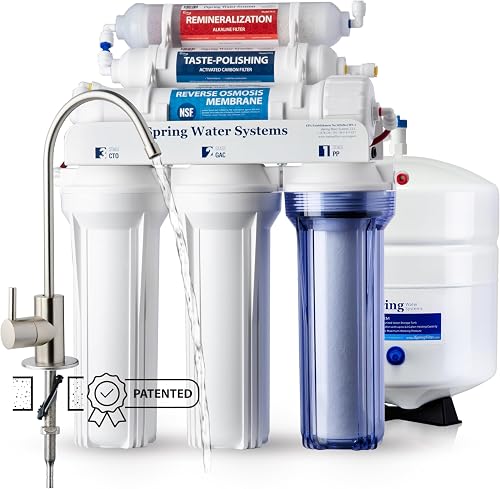
Waterdrop fits narrow cabinet layouts; iSpring fits kitchens with room for a separate tank. Measure usable space around plumbing and filter access before choosing either system.
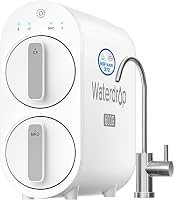
The G5P500A body measures 16.69 x 5.69 x 13.9 inches. Its narrow shape helps when a garbage disposal, drain trap or cleaning supplies already occupy much of the cabinet.
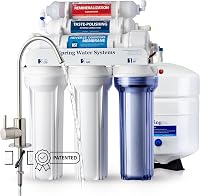
iSpring gives dimensions of 15.5 x 16 x 18 inches for the RCC7AK-BN. Don't treat those measurements as a complete installation footprint; plan separately for the included tank, tubing and service access.
A unit can fit through the cabinet door yet be awkward to maintain. Leave enough room to reach shutoff valves, disconnect tubing and remove filters without dismantling the whole setup.
Who should choose Waterdrop vs iSpring for a small cabinet?
Choose Waterdrop when a separate tank would block access or force you to give up useful storage. Its shape is especially helpful in a crowded cabinet where the available space is tall and narrow.
Skip it if the only possible location leaves the filters or electrical connection hard to reach. A tankless label doesn't remove the need for service clearance.
Choose iSpring when you can give the filtration assembly and tank dedicated space. Skip it if fitting the tank would pinch tubing, crowd plumbing or make the main water shutoff difficult to reach.
For more on these layouts, see tankless vs tank reverse osmosis systems. Compare other cabinet-friendly options in our guide to under-sink reverse osmosis systems.
How will each system handle your daily water use?
Waterdrop makes sense for repeated draws without a separate reserve tank; iSpring suits routines that leave time for a tank to refill. Compare your largest usual draw, not just the number of people at home.
The G5P500A has a 500 GPD production capacity and a stated maximum flow of 1.31 liters per minute. The RCC7AK-BN has a 75 GPD production capacity, with treated water held in its storage tank.
GPD means gallons per day under specified conditions. It isn't the amount that comes out of the faucet each minute, and it doesn't make Waterdrop's faucet delivery a simple multiple of iSpring's.
When does a storage tank help?
A storage tank holds water made earlier, so a modest daily production figure can still serve short, routine draws. Glasses of water spread through the day give the system time to rebuild its reserve.
Large back-to-back draws use that reserve faster. If you fill several bottles and a cooking pot each morning, check the usable tank volume and refill guidance before choosing a tank-based system.
Don't assume a tank's physical size equals its usable water volume. Part of a typical RO pressure tank holds compressed air, which helps push water toward the faucet.
When does tankless delivery make more sense?
Tankless delivery suits buyers who want to avoid managing a separate stored reserve. Still, filling a large container takes time, so judge the stated faucet flow against the containers you actually use.
Cold feed water, pressure and filter condition can affect RO production. Neither system's daily capacity should become a promise that every kitchen will get identical delivery.
Write down your heaviest routine use before ordering. A household that drinks from small glasses may need less burst capacity than one that fills large bottles before leaving home.
How do filtration and mineral stages compare?
Choose by the substances you need reduced, rather than the number of filter stages. Both models combine RO with mineralization, but their contaminant claims need to match your water source.
Waterdrop uses 8 stages with a 0.0001 μm RO membrane. Waterdrop says the G5P500A reduces PFOA, PFOS, chlorine, lead, fluoride and heavy metals.
iSpring uses 6 stages and claims reductions of 93–98% for TDS and 96–99% for PFAS, along with reductions for chlorine, fluoride, lead and other substances. These figures describe iSpring's claims, not guaranteed results at every tap.
Both brands state NSF/ANSI 58 certification, and iSpring specifies full-system coverage. Waterdrop also states NSF/ANSI 372 certification, which concerns lead content in drinking-water system components.
Check the exact model and applicable reduction claims in the NSF drinking water treatment unit listings. Certification to a standard doesn't mean every possible contaminant reduction is covered.
Start with your water source
Use your utility's water quality report, or a current laboratory report for a private well, to identify the problem you want to address. Taste alone can't identify every water concern.
Waterdrop specifies a maximum supported feed-water TDS of 500 ppm. If your source exceeds that limit, skip this model unless Waterdrop confirms an appropriate treatment plan for your supply.
A handheld TDS meter measures dissolved solids as a group. It can't tell you whether water contains a particular metal, chemical or microorganism.
Choose mineralization for taste preferences
Both systems add minerals after RO filtration. Waterdrop names calcium, magnesium, sodium and potassium, while iSpring uses its natural mineral AK stage.
Minerals can change the taste of RO water, but alkaline wording isn't a reason to expect a health benefit. There isn't enough information here to choose either model for a precise final pH or mineral dose.
Our guide to reverse osmosis systems with remineralization explains how mineral stages fit into an RO setup.
Which installation is more practical for your kitchen?
iSpring avoids electrical work and makes faucet fastening accessible from above; Waterdrop needs power and a drilled countertop opening. Both still require careful planning for the supply, drain and drinking-water faucet.
The RCC7AK-BN has quick-fitting connections, color-coordinated tubing and an adapter compatible with 1/2-inch NPT and 3/8-inch compression fittings. Check your actual shutoff valve connection rather than assuming the adapter will suit every kitchen.
Its top-mounted faucet fastener removes the need to tighten that connection from beneath the sink. This helps where the basin makes reaching upward difficult, though it doesn't remove the need for a suitable faucet opening.
Waterdrop includes a mechanical faucet, a manual and 2 pre-installed filters. Its faucet measures 6.6 x 3.2 x 11.3 inches, so check reach over the sink and clearance beneath shelves or window trim.
Plan the work before disconnecting anything
Identify the cold-water shutoff, the drain connection location and the faucet position first. Read the model's instructions before buying extra fittings or making permanent holes.
Waterdrop requires countertop drilling for its faucet. Get permission where needed, and use someone equipped for the countertop material if drilling falls outside your skills.
For the electrical connection, confirm suitable outlet access before installation day. Don't build the layout around a cord stretched across a wet area or trapped behind equipment.
Our reverse osmosis installation guide covers the usual steps. If drilling, plumbing access or electrical work complicates the job, see the factors behind RO installation cost.
Finish startup before drinking the water
Follow the model's flushing and startup directions completely. New filters and mineral stages may require flushing, and the first water through the system isn't a shortcut around that process.
Check connections during startup and again after the system has operated. Dry surfaces around fittings make small leaks easier to spot than a damp cabinet floor does.
What do drain water and appliance connections change?
Waterdrop gives a clear drain-water ratio; either system needs a separate plan if it will serve a refrigerator. Account for that extra use before routing tubing through cabinets.
Waterdrop states a 2:1 pure-to-drain ratio, meaning 2 parts purified water for 1 part sent to the drain under its stated conditions. Actual operation can vary with feed water and system use.
There isn't a comparable drain ratio here for the RCC7AK-BN, so don't calculate water savings between these models. Choose with the known ratio in mind without assigning iSpring an assumed figure.
Both systems send rejected water to a drain as part of RO treatment. Keep the drain tubing positioned according to the instructions, and don't kink it to make the cabinet look tidier.
Treat refrigerator supply as a separate installation
The G5P500A supports appliance connections with Waterdrop XT. The RCC7AK-BN supports most refrigerators, with an ICEK ice maker kit available separately.
Confirm accessory compatibility and the refrigerator's required supply pressure before connecting either system. A compatible connection kit doesn't remove the need to check the appliance's water requirements.
Longer tubing runs, extra fittings and simultaneous draws can affect delivery. Plan a route that protects tubing from cabinet doors, sharp edges and stored items.
How should you plan filter care and upkeep?
Choose the system whose replacement routine you can carry out without moving half the cabinet. Filter access, correct parts and a written schedule matter more over time than a tidy installation photo.
iSpring offers F4AK, F9K, F19K75 and F28K75 replacement sets labeled for 6 months, 1 year, 2 years and 3 years. Those labels don't mean every filter inside a set lasts for the entire named period.
Use the manual to map each cartridge to its own interval. Sediment filters, carbon filters, membranes and mineral stages can have different replacement needs.
Use the clear housing as one maintenance clue
iSpring's transparent first-stage housing lets you see sediment buildup. That makes it easier to notice a dirty sediment filter, but it doesn't show the remaining capacity of the other stages.
Don't wait for every filter to look dirty or for the water to taste different. Some filters can need replacement without giving a clear visual or taste warning.
For Waterdrop, match replacement cartridges to the G5P500A, since similar model names can cause confusion. Confirm the required parts and access method before committing to the system.
Keep a simple service record
Record the installation date, each filter change and any change in flow or taste. Follow the model's cleaning, flushing and sanitizing directions when servicing it.
Tank-based systems also need attention to tank pressure when delivery problems arise. Follow the manual's procedure rather than adding air while guessing at the tank's condition.
Use our guide to how long reverse osmosis filters last to plan the work. iSpring also provides lifetime technical support from Atlanta for installation and replacement-filter questions.
Which buying mistakes are easiest to avoid?
Avoid choosing by brand name, stage count or GPD alone. Each of those shortcuts can hide the detail that makes a system awkward in your kitchen.
- Measuring only the equipment: allow space for service, tubing bends, valves and the cabinet door.
- Ignoring water pressure: check the manual's feed-water requirements before assuming either system will suit your supply.
- Choosing by household size alone: compare your largest routine water draw and how quickly you need the next one.
- Treating clear water as proof: identify source-water concerns and match them to relevant reduction claims.
- Forgetting replacement access: make sure you can reach every service part after installation.
Also avoid counting only the initial equipment. Replacement cartridges, installation help, accessories, electricity where required and water sent to the drain all belong in the ownership plan.
Don't choose a tankless system just because it sounds newer, or a tank system just because its layout is familiar. Pick the arrangement that you can install, use and maintain comfortably.
Waterdrop vs iSpring: the final decision
Choose Waterdrop G5P500A if removing the separate tank solves a real cabinet-space problem, you have suitable power and its feed-water limits suit your supply. Skip it if adding electrical access or drilling the faucet hole makes the project impractical.
Choose iSpring RCC7AK-BN if you have room for its tank, want operation without electricity and can let stored water replenish between larger draws. Skip it if tank space or repeated large draws make that arrangement a poor match.
For alternatives within each brand, compare our guides to Waterdrop reverse osmosis systems and iSpring reverse osmosis systems. Apply the same cabinet and water-use checks to each model rather than carrying this verdict across the whole brand.
Before ordering, use how to choose a reverse osmosis system to turn your measurements, source-water needs and daily routine into a final checklist.
Frequently asked questions
Is Waterdrop or iSpring better for reverse osmosis?
Choose Waterdrop G5P500A if cabinet space is tight and an outlet is available. Choose iSpring RCC7AK-BN if you have room for a storage tank and want operation without electricity.
These 2 models suit different kitchen layouts, so compare installation needs and your largest routine water draw before choosing.
Does the Waterdrop G5P500A need electricity?
Yes, the Waterdrop G5P500A uses corded electric power. Confirm that a suitable outlet is within reach before ordering, and keep its access clear when planning the cabinet layout.
If adding electrical service would complicate the job, the nonelectric iSpring RCC7AK-BN is the more practical choice, provided its tank fits.
Does iSpring RCC7AK-BN include a storage tank?
Yes, the iSpring RCC7AK-BN includes a storage tank, brushed nickel faucet and extra tool set. Measure space for the tank separately from the filter assembly, then allow access to valves and filter housings.
Stored water supports routine draws, but the system needs time to replenish water after the reserve runs low.
Which system has NSF/ANSI 58 certification?
Both brands state NSF/ANSI 58 certification for these models, with iSpring specifying coverage for the entire RCC7AK-BN system. Waterdrop also states NSF/ANSI 372 certification for the G5P500A.
Match the exact model and certified reduction claims to your water concern rather than treating a standards number as coverage for every contaminant.